Police brutality: Nakuru carpenter left incapacitated after police assault during anti-fuel hike protests
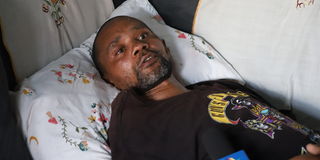
43 year old, Jeremiah Mwaura, lies in his living room at his home in Kiratina, unable to move after he was allegedly assaulted by police during May anti fuel price protest that left him paralyzed

The hands that made furniture to put food on the table now struggle to hold a cup of water. As we arrived Jeremiah Mwaura, 43, lay on his living room seat in his modest home in Kiratina, Nakuru East. His body unable to do what it once did with ease. He cannot stand, walk or return to the carpenter work that sustained his wife and three children.
Beside him is his wife, Jane Wangui, who has had to trade her casual jobs for the role of full-time caregiver.
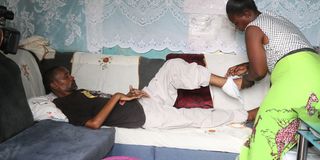
Mwaura's wife Jane Wangui , attends to her husband at their home in Kiratina after her husband was allegedly assaulted by police during May anti-fuel price protest that left him paralyzed

Their lives changed on May 18, 2026, when Mwaura says he was caught up in protests against high fuel prices along the Nakuru-Nairobi Highway at Free Area.
What began as an ordinary trip to Nakuru city center to buy materials for his work ended with Mwaura allegedly being assaulted by police officers, leaving him with a severe spinal injury.
Months later, the family is still waiting for answers, justice and compensation as they struggle to keep him healthy and in treatment.
“I was beaten when I went to pick up my work supply,” Mwaura said.
He remembers leaving his home at 7 am to get the supplies and at about noon after buying the items he needed to return home. He boarded a tuk-tuk home, but as he approached Free Area, he says he found the road lit with tyres and heavily guarded by police officers.
Then, chaos erupted. He was chased by police while carrying his work supplies in a sack and shortly he had a smack on his neck. Mwaura said he pleaded with the officers to stop beating him
“I was hit by a baton behind my neck. I fell down and my leg was injured. I was crying when I asked them why they were beating me yet I was not part of the protesting youth,” he recalled.
He was eventually picked up by a Red Cross ambulance and taken to Nakuru County Teaching and Referral Hospital, where he was admitted.
His wife did not know what had happened.
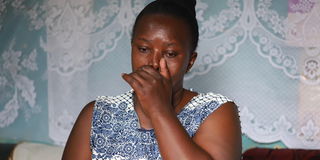
Mwaura's wife Jane Wangui , breaks down into tears as she explains the hardship in her house after her husband was allegedly assaulted by police during May anti-fuel price protest that left him paralyzed
Wangui had been desperately trying to reach her husband after he called to tell her that he was stranded in Free Area. She remembers hearing gunshots and watching vehicles leave the area as she repeatedly tried to establish his whereabouts.
Then one of Mwaura's friends arrived with devastating news.
The friend called from Mwaura's phone put it on speaker, Wangui said she heard that her husband had been beaten and was in a confused state, adding that the person on the call told her to go to Nakuru PGH where her husband was. What she found was a man she barely recognized, his entire body was paralyzed after the incident.
“When I got to PGH, he was paralyzed all over his body. They told me he had a spinal injury. He spent about three weeks at the hospital before being referred to other facilities for specialized treatment,” she said.
The family eventually travelled to Tenwek Hospital, where Mwaura underwent spinal surgery. The operation helped restore some movement, but he remains unable to stand.
“Now he can sit down and make a few hand movements, but he can't get up,” Wangui noted.
For the mother of three, the hospital journey became a battle of its own.
She spent weeks beside her husband's hospital bed, washing him, feeding him and helping him with basic needs. At one point, the family struggled to raise money to continue treatment.
According to the family they have since spent more than Sh 600,000 on medical treatment, transport, medication and related expenses.
The financial burden has pushed them deeper into hardship.
Wangui notes that Mwaura was the family's main breadwinner. Without his income, school fees have become difficult to pay, rent has fallen into arrears and even basic medical supplies have become a burden.
“Mwaura requires regular physiotherapy and medication. A therapist costs about Sh1,000 per session, with therapy recommended three times a week. Transport to Tenwek is another expense the family can barely afford with each trip requiring over sh 20,000 because of his condition. At home, I have become his aid, I cannot do casual jobs as I used to because he needs constant care,” she noted, explaining her struggle, as her husband's diapers alone cost about Sh1,900 a packet and last only a few days.
The family has survived on the generosity of relatives, friends, neighbors and well-wishers, but Wangui says even those who initially helped have reached a point where they can no longer sustain the family's needs.
Human rights defender, David Western, noted that over 20 families in Nakuru are seeking justice and compensation over their loved ones who were either killed or injured by police in different protests that have happened in Nakuru since 2023. He called upon the government to give reasonable compensation to victims of police brutality to enable them rebuild their lives.
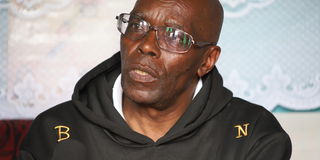
David Western a human rights defender, calls on the government to compensate families that have suffered police brutality and in amounts that can help the families rebuild their lives
"I am calling on the government to compensate families that have suffered police brutality and in amounts that can help the families rebuild their lives," Western noted