Nakuru county rolls out HIV preventive drug amidst high prevalence rate
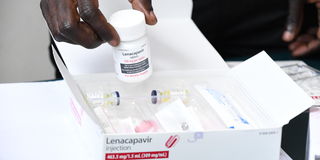
Some of the oral tablets taken with water as part of a loading regimen to ensure full protection from the onset after the injectable

Nakuru County has officially launched the injectable long-acting Pre-Exposure Prophylaxis (PrEP) — a preventive medication for HIV-negative individuals who are at high risk of contracting the virus.
The medication is administered through a subcutaneous injection of 1.5ml, accompanied by initial oral tablets taken with water as part of a loading regimen to ensure full protection from the onset.
According to the Deputy County AIDS and STIs Coordinator, Martha Kahora, this launch introduces a new, more convenient method of HIV prevention for people who do not have the virus but are considered at risk — including those with HIV-positive partners and sex workers.


Deputy County AIDS and STIs Coordinator, Martha Kahora, addresses the media during the launch of the injectable long-acting Pre-Exposure Prophylaxis (PrEP) — a preventive medication for HIV-negative individuals who are at high risk of contracting the virus on March 26 at PGH.
Previously, the county relied on oral PrEP (daily pills), which presented significant adherence challenges. Many recipients forgot to take their medication daily, and not everyone finds a daily pill regimen practical or sustainable.
The injectable forms address these barriers and come in two intervals: Cabotegravir (CAB-LA), administered every two months, and Lenacapavir, administered every six months, for which the county flagged off a total of 3,569 injections across both formulations.
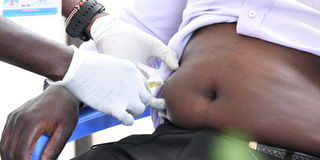
A patient being administered the injectable long-acting Pre-Exposure Prophylaxis (PrEP) subcutaneously which was followed by oral tablets taken with water as part of a loading regimen to ensure full protection
Irene Nyambura, a resident of Nakuru, was the first person to receive the injectable PrEP. She found the process simple and reassuring. Unlike oral PrEP, which requires a daily pill, the injectable form only asks one thing: to remember the date of your next appointment. She adds that even that is manageable, since you can set a digital reminder on your phone.
"As a pregnant woman, I was exposed to the disease. That is what made me want to get vaccinated," she says, adding that she now feels free, unafraid, and safe.

Irene Nyambura, the first person to receive the injectable PrEP in Nakuru, receives her dose of oral tablets as part of a loading regimen to ensure full protection
Geoffrey Mwangi, 62, a small business owner from Nakuru, who was also among the first to receive the injectable PrEP, says having previously used oral PrEP, he welcomes the shift, noting that the biggest challenge with the daily pill was consistency.
“The daily pill requires you to wake up every day and take it consistently, which is a challenge. This one lasts six months — that is why this is a good initiative,” he says.

Geoffrey Mwangi, 62, among the first patients administered the injectable PrEP in the county after the official launch on March 26
Mwangi is optimistic about the future of HIV prevention, noting that progress has already begun and that he believes a lasting solution is within reach.
The rollout begins with ten health facilities across the county:
Naivasha Sub-County Hospital, Gilgil Sub-County Hospital, Gilgil Centre of Hope, Bahati Sub-County Hospital, Nakuru Provincial General Hospital (PGH), Langa Langa Sub-County Hospital, Hope Worldwide DICE, Rongai Health Centre, Njoro Sub-County Hospital, and Molo Sub-County Hospital.
The launch comes against a concerning backdrop of rising HIV infections in the county. Data from the National Syndemic Diseases Control Council (NSDCC) has ranked Nakuru County first nationwide in AIDS-related deaths.
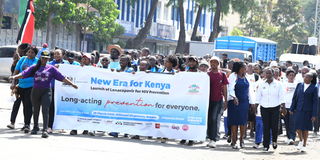
The official flag off of the injectable long-acting Pre-Exposure Prophylaxis (PrEP) — a preventive medication for HIV-negative individuals who are at high risk of contracting the virus on March 26 along Kenyatta Avenue.
A recent report revealed that young people aged 15 to 24 account for 36 percent of all new adult HIV infections in 2024, placing adolescents at the epicenter of the epidemic. Health officials have raised particular alarm over this trend.
Currently, the county has over 46,000 people living with HIV, with a prevalence rate of 6.3 percent. The goal of this intervention, alongside others, is to drive that number toward zero.