Rise in new HIV infections among Nakuru teens worries health officials
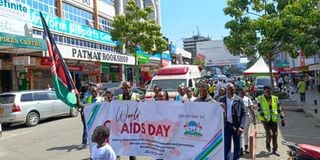
Nakuru county marked World Aids Day on December 1 with a march along Kenyatta Avenue

Health officials in Nakuru have raised concerns over the increasing cases of new HIV infections among the adolescents.
This is after a new report revealed that the group is still at the epicenter of new infections, with young people aged 15 to 24 accounting for 36 per cent of all new adult infections in 2024.
The same age group, according to the 2025 progress report, also appears prominently in indicators of gender-based violence and early pregnancy, with over 8,500 adolescent pregnancies recorded, among which 42 per cent are linked to sexual and gender-based violence (SGBV) cases.


“We are concerned about teenage infections and deaths, so we are mobilizing young people to take action, whether through abstinence, testing, or using contraceptives to protect themselves. Those without the virus must also ensure they stay protected,” says Racheal Kiuna, the county AIDS and STI Coordinator.
According to Kiuna this convergence of unprotected sex, group sex, violence, peer influence, and treatment abandonment continues to fuel the county’s youth-driven epidemic.
She spoke during the commemoration of the World AIDS Day under the national theme “Race to End AIDS-Related Deaths Among Men and Boys,” a slogan that mirrors the epidemiological picture emerging from Nakuru’s latest figures.
The new data however, shows that while the county has reduced its overall HIV burden, viral suppression remains one of its biggest challenges.
The data indicates that only 58 per cent of people on treatment are virally suppressed. Suppression is lower among men, at 53.5 per cent, and falls sharply among children, who record a suppression rate of 33.7 per cent.
During the period under survey the county recorded over 51,100 people living with HIV in 2024, ranking ninth nationally, down from sixth position last year.
The overall HIV prevalence in the county stands at 2.4 per cent, but the burden is unevenly distributed, with prevalence among women at 3.3 per cent, more than double that of men, which stands at 1.6 per cent.
Kiuna says the shift in national ranking reflects progress, but warns that the county must confront the pockets of vulnerability that persist beneath the headline numbers.
“In Nakuru County, we have decided to start with prevention because it is better to prevent than to treat. We are testing more people, linking them to care faster and preventing more infections,” she says.
The report shows that Nakuru has achieved 98 per cent awareness of HIV status among people living with HIV, and 89 per cent of those who know their status are on treatment.
Despite these challenges, Nakuru has made substantial strides in preventing infant infections. The county recently celebrated a milestone of more than 200 children who reached their second birthday HIV-free, after being born to mothers living with HIV.
This achievement comes as mother-to-child transmission has dropped from 15.4 per cent in 2019 to 6.1 per cent in 2024, a decline Kiuna describes as “the strongest proof” that prevention programs, including antenatal testing, maternal ART coverage, and follow-up of exposed infants, are working.
“The celebration of those 200 HIV-free children is evidence that we can get to zero. By 2030, our goal is that no child in Nakuru will acquire HIV at birth or through breastfeeding. This is achievable with the systems we are strengthening now,” Kiuna says.