Man assaulted by police during May anti-fuel hike protests in Nakuru dies
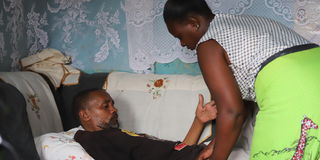
Jane Wangui attends to her husband while he was sickly at their home in Kiratina on 2 september,2026.

At her home in Kiratina within Nakuru East, Jane Wangui Naika’s family is busy making arrangements for the burial of her late husband Jeremiah Mwaura Naika.
Mwaura succumbed in September 22, to injuries he suffered from his encounter with Police brutality five months ago during anti-fuel hike protests.
Mwaura, in his earlier interview with Mtaa Wangu, claimed to have been assaulted by police officers in the Kiratina area who mistook him for a protester as he walked home.

The police officers allegedly struck him with a baton, an injury that would go on to paralyze him and ultimately lead to his death.
He spent three weeks at Nakuru County Teaching and referral hospital and made repeated visits to Tenwek Hospital, including a surgery, as his body struggled against an injury his family could barely afford to keep treating.
Speaking to Mtaa Wangu following her husband’s death Wangui says life has not been easy. The death has robbed her of a man she had hoped to grow old with.
She breaks into tears as she recounts how, just the previous evening, she had cared for her husband whose condition had deteriorated before waking up to find him dead.
“Hours earlier, Mwaura had complained of pain, asked for water, before he told me I could go back to sleep since he was feeling. Those were the last words from my husband at 10.45 pm,” she notes.

Jane Wangui breaks into tears as she explains who her husband died at their home in Kiratina on 22 September,2026
Wangui notes that she became his full-time caregiver, watching a man who once supported his community reduced to depending on her for every need. She organized fundraisers when hospital bills outpaced their means.
She rearranged her days around his appointments. And still, she says, it was not enough, not because she failed him, but because the compensation she believes was owed to them by the Independent Policing Oversight Authority (IPOA) never came in time.
"I missed three hospital appointments in Tenwek because we lacked the money to go there. We had already spent Sh 600,000 on treatment and we required more than Sh 20,000 for each hospital trip which I could not raise. Had IPOA compensated us on time, maybe we would be talking of a different situation, not my husband's death," she says before taking a long pose.
Wangui notes that her grief is one sharpened by a sense of abandonment. "My government has failed me twice. First when officers assaulted a man walking to work, and again when the system meant to hold them accountable moved too slowly to make a difference while he was still alive to benefit from it," Wangui says.
"I'm begging the government to help me," she says, a plea rooted now not in hope of recovery, but in hope of accountability.
The Independent Policing Oversight Authority (IPOA) IPOA through its chairperson Dr Duncan Ojwang' has confirmed that the matter was formally reported and registered under case management number IPOA/CMU/2341/2026.
Following Mwaura's death, the Authority says the case has been reclassified from an assault investigation to one involving death resulting from police action.
The Authority noted that it is awaiting medical documents confirming his death to complete the case amendments and proceed under the new classification.
On compensation, IPOA says Mwaura's claim was initially processed as an injury case, with the documents submitted to the Panel of Experts on Compensation of Victims of Demonstrations and Public Protests.
“The process is ongoing and once we receive the documents confirming his death, the widow will be advised on pursuing compensation as a fatality victim,” said Mr Ojwang’.