High turnout at Rhonda free eye screening camp highlights growing demand for eye care services
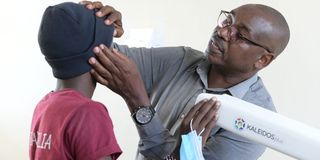
An optometrist adjusts a patient’s head as he positions a screening device during the eye clinic at Rhonda Health Centre, which drew 581 people

For four years, Dolrose Achieng struggled to read her Bible, forcing her to go without one of the activities she enjoyed most.
The 48-year-old says she had difficulty seeing clearly but could not afford hospital visits, with competing household needs leaving her unable to seek treatment.
“I could not see properly and had stopped reading my Bible. The problem had persisted for about four years,” she says.

She also says she had experienced eye irritation and itching, which she’d been told by medics at the clinic is associated with allergies.
Achieng was among residents who benefited from a two-day free eye screening and medical camp at Rhonda Health Centre, where she underwent an assessment and received spectacles.
She says she was delighted to finally have glasses that would allow her to carry her Bible to church and read comfortably.
“I am happy that I will now be able to carry my Bible to church and read,” she says.
We met Isaac Mwangi who was rapidly blinking and squinting his eyes despite having worn prescribed tinted spectacles for about seven years.
He says he had been struggling with eye problems, particularly when looking at distant objects, bright things, and sunlight and had spent Sh 12,000 on them, but says the glasses he previously used did not adequately address his vision problems.
Following an assessment at the camp, he received spectacles suited to his needs, which he says have improved his ability to see clearly.
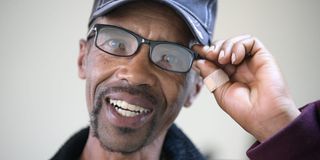
Isaac Mwangi adjusts his new spectacles after being examined at the Rhonda Health Centre eye clinic. He says the tinted pair he previously used, which cost him Sh12,000, did not adequately address his vision problems
The two were among 581 people who were attended to during a free eye screening and medical camp organized by the Department of Health Services in partnership with SKYGEN International Foundation, the Foundation for Preventive Health and OneSight EssilorLuxottica Foundation.
The exercise, which took place at Rhonda Health Centre on November 9 and 10, resulted in 415 spectacles being dispensed, while 33 patients were referred to Nakuru County Teaching and Referral Hospital for specialized care.
The screenings covered eye conditions, refraction and spectacle dispensing, alongside blood pressure and random blood sugar checks.
Speaking during the exercise, County Eye Health Coordinator John Gitahi says the intervention seeks to address barriers that prevent people from accessing spectacles, despite having vision problems that can be corrected.
He says refractive errors are the second leading cause of avoidable blindness in Kenya, yet many people continue living with poor vision because they cannot access or afford corrective spectacles.
“Refractive errors affect people who cannot see clearly, but whose vision can be improved through spectacles,” he says.
He explains that these include short-sightedness, where a person struggles to see distant objects, and long-sightedness.
Another common condition is presbyopia, which affects near vision and is particularly prevalent among people aged 45 and above.
“For presbyopia, we provide reading glasses. For short-sightedness and other refractive errors, we prescribe spectacles after assessing the person and determining the appropriate lens power,” he says.
Gitahi says the condition can make everyday activities such as reading difficult, with some people having to hold reading materials farther away to see clearly.
He notes that while short-sightedness and long-sightedness can have a genetic component, age-related near-vision problems are common among older people.