Calls for tougher regulations as political campaign graffiti continue to deface public and private spaces

A political graffiti writing on one of the walls in Nakuru East constituency

As one walks through residential estates and the Central Business District, it becomes difficult to ignore walls, roads, and even key infrastructure marked with campaign messages from aspiring leaders.
In Nakuru East, the situation appears particularly pronounced. Not only are house walls covered in bold inscriptions, but schools, stadiums, roads, and culverts have also become canvases for political messaging.
Consequently, many residents are questioning the intent behind the repeated large-font writings, often duplicated across multiple surfaces within short distances.


A political graffiti writing on one of the walls in Nakuru East constituency
Moreover, what seems to be emerging is a silent competition among aspirants vying for visibility ahead of future elections. For instance, those eyeing the parliamentary seat in Nakuru East—including Fadhili Musuri, Wakili Ndumia, and Maina Wakabura appear to be in a race to occupy any available space first.
Similarly, the contest among MCA hopefuls has intensified, particularly in Nakuru West, where areas such as the Menengai Oil Refinery perimeter wall have been heavily targeted.
However, this trend did not begin recently. In fact, some of the defacing dates back to the previous year, coinciding with the early rollout of campaign messages and manifestos by both sitting leaders and new aspirants.
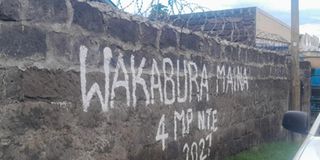
A political graffiti writing on one of the walls in Nakuru East constituency
As a result, the political environment has gradually turned into a prolonged campaign period marked by rivalry and attempts to outshine competitors.
Meanwhile, defacing property whether public or private through graffiti or unauthorized markings is generally prohibited.
Such acts are often classified as vandalism or public nuisance, thereby violating laws that safeguard public order and environmental aesthetics.
Consequently, there’s need for stricter enforcement to curb the practice and restore the town’s visual appeal.