Heartbreak for rally fans as iconic Miti Mbili jump is shut off
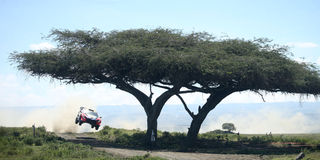
The legendary Miti Mbili jump located inside Kedong Ranch in Naivasha

For years, it was the image that defined the Safari Rally.
A rally car soaring through the air, framed perfectly between two sprawling acacia trees against the backdrop of Kenya's vast skies. Captured by photographers from around the world, the scene became synonymous with the World Rally Championship's return to Kenya and helped establish the Safari Rally as one of the most spectacular events on the global motorsport calendar.
Known simply as Miti Mbili Jump, "Two Trees", the iconic jump on the Kedong stage in Naivasha grew into one of the most recognizable landmarks in world rallying. Its global appeal reached new heights in 2024 when footage from the jump was voted the WRC's "Best Action of the Year," cementing its place in rally folklore.

But now, one of the Safari Rally's most celebrated locations appears destined to become a memory.
The area has been fenced off following developments on the privately-owned land where the famous jump is located, effectively ending a route that has produced some of the most iconic images in modern rallying.
For fans, Miti Mbili was more than just a viewing point. It was a place where spectators would gather for hours under the Naivasha sun in Kedong, waiting for the next car to appear.
Dust clouds would rise on the horizon before rally cars burst over the crest, launching spectacularly into the air between the two acacia trees.
The resulting photographs became a global symbol of the Safari Rally.
Sports journalist and photographer Mwangi Kirubi, who has documented the event for years, recently reflected on the apparent loss of the landmark.
"So Miti Mbili is all but gone," he wrote on social media. "From the fencing around the area, I see it practically impossible to hold a rally stage there."
Kirubi acknowledged that while many fans will be saddened by the development, the rally takes place on private land and landowners have legitimate plans for their property outside the few days the event occupies it annually.
His sentiments are echoed by WRC Safari Rally Clerk of the Course George Mwangi, who described Miti Mbili as one of the highlights of the event's modern era.
"It was one of our highlights. It is known worldwide. We had a consultant who came to work with us this year and when we passed through Miti Mbili, he insisted we stop so he could take a photo because he had heard so much about it," said Mwangi
Mwangi noted that the site's significance extends beyond the WRC, having featured in Kenya National Rally Championship events for many years.
"For us maybe we take it for granted, but everyone wanted to see Miti Mbili. We have priceless memories from that jump," he noted.
Yet even as fans bemoan the apparent end of the famous landmark, many agree that the spirit of the Safari Rally has always been bigger.
The rally's reputation has been built on Kenya's unique combination of challenging terrain and breathtaking scenery. From the notorious Fesh Fesh dust that can swallow cars and blind drivers, to muddy sections created by sudden rains, the Safari Rally has consistently tested the world's best competitors.
Equally iconic are the images of rally cars racing through landscapes shared with wildlife. Photographs of cars speeding past giraffes, zebras and antelopes have become a signature of the Safari Rally, showcasing a setting unlike any other event on the WRC calendar.
As Kirubi rightly observed, "Safari Rally cannot be tied down to two trees and a jump."
Mwangi believes the loss of Miti Mbili also presents an opportunity to discover new landmarks.
"We are trying to spice up the event by finding new routes and we are confident we might come up with a new Miti Mbili somewhere. We have vast terrains to discover." Mwangi noted.
He revealed that organizers are already exploring fresh stages for future editions of the WRC rally, promising new experiences for drivers and spectators alike.
The loss of Miti Mbili marks the end of an iconic chapter in Safari Rally history. But while fences may have closed off one of Kenya's most famous rally landmarks, they cannot fence off the spirit of the Safari Rally.
Somewhere across the vast plains and valleys of Naivasha, another unforgettable moment is waiting to be discovered.