Breaking barriers: Joan Baraza whistling hope into basketball game in Ndabibi
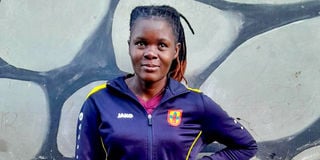
Joan Baraza is a basketball referee and training in Emmanuel Primary School, Ndabibi.

At Emmanuel Primary School in Ndabibi, Naivasha Joan Baraza is steadily nurturing a passion for basketball among her pupils despite overwhelming challenges that continue to slow down the sport’s growth in the area.
Baraza, a teacher at the school, only played basketball during her high school years. However, although she did not pursue the game competitively after completing high school, her love for sports never faded. Instead, it evolved into coaching and refereeing.
Today, she balances her role as a teacher with mentoring young players and officiating matches, becoming one of the few trained referees in Ndabibi.

“I only played in high school and then stopped,” she explains. “But when basketball was introduced in junior school under CBC, I saw an opportunity.”
Since introducing basketball at her school, Baraza has witnessed a noticeable shift in students’ attitudes toward the sport. Initially, many learners were unfamiliar with the game. However, once she began training them, interest grew rapidly.
“They were more interested, especially when I introduced it. Many wanted to join,” she says.
Nevertheless, the excitement was quickly dampened by one major obstacle: a lack of facilities. The school does not have a basketball pitch. Instead, the team relies on a neighbouring high school’s grounds, which only have goal posts but no proper court. Previously, they trained on a netball pitch using netball rings.
As a result, training sessions are limited to basic shooting drills, making it difficult to develop advanced skills or prepare effectively for competitions.
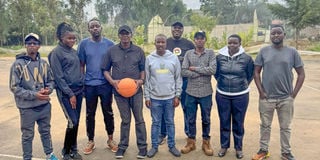
(Second Left) Joan Baraza during a referee training in Naivasha.
Beyond infrastructure challenges, transportation and financial constraints have also slowed progress. Organising tournaments requires significant resources, and since schools are located far apart, travel costs become a major burden.
“In Ndabibi, we are only two teachers training basketball. There are no other teams nearby. When we want to organise a tournament, it becomes very challenging because of distance and money,” she explains.
Moreover, she points out that many referees in the region lack formal training. Most rely on copying what they see or reading basic materials, which often leads to mistakes during matches.
For Baraza, attending referee clinics has been transformative. Not only has it improved her officiating skills, but it has also strengthened her coaching ability.
“I learned a lot about fouls, violations, how the pitch should be, and how to train learners properly,” she says. “Some of us were making mistakes because we didn’t know the rules. Now at least we have ideas.”
She remains eager to attend more training sessions so she can continue improving and help raise standards in the region.
As one of the few female referees in her area, Baraza is determined to inspire more girls and women to join the field. She plans to start by mentoring her own learners and encouraging neighbouring schools to embrace basketball.
“From Ndabibi, I will encourage other schools to join me. I am interested in teaching ladies what I have learned so we can be more and help one another,” she says.
Last year, she had a promising team ready for competition. However, logistical challenges prevented them from participating, leaving some students demoralised. Even so, she continues to train them, hopeful that future opportunities will arise.
Despite the numerous hurdles, Baraza has not considered giving up. As a CBC teacher handling Creative Arts and Sports, she discovered basketball while teaching the curriculum. When she introduced it to her learners, their enthusiasm became her greatest motivation.
Looking ahead, Baraza is calling on the government and sports stakeholders to invest more in infrastructure and training. Since basketball is now part of the junior school curriculum, she believes facilities should match the educational reforms.
“I think in every ward, at least three schools should have proper basketball pitches and facilities. We need more clinics and seminars so more people can learn,” she urges.
Although the journey is filled with obstacles, her determination continues to keep the sport alive in her community.