What Gen Zs don’t like about Nakuru city

Friends take photos at the Food Festival Event in May 2025.

Nakuru may have earned the title of Kenya's fourth city, but for some of its residents, the upgrade has not necessarily translated into the kind of urban experience they expected.
From roads riddled with potholes to a nightlife scene that some young people consider repetitive, underwhelming, and subpar, residents have taken to social media to air their frustrations about the city they call home.
For some, finding somewhere to spend a weekend beyond the usual clubbing spots is a challenge as others feel the city lacks the recreational facilities and social activities expected of a growing urban center.

One of them, Kingsy Kenah, takes issue with what she describes as the city's changing social atmosphere, particularly the number of school-going teenagers hanging around the town centre.
"Tukienda tao kumejaa highschoolers, East, West, South, everywhere highschoolers. Mnataka..." she says, questioning the situation.
Another TikToker, Kimani+, who says she was born and raised in Nakuru, has a longer list of grievances.
Roads, she says, are in poor condition, while the politicians responsible for addressing the problem are not doing enough. She argues that road maintenance should be undertaken regularly, at least once a year, rather than leaving residents to contend with deteriorating roads.
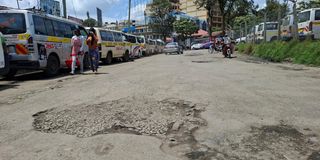
A pothole on Market road along 4NT, Mololine Sawa stages and Top market all the way to Station road
Additionally, she says the city has very few recreational spaces where friends, couples and people looking for somewhere to spend time together can go. One of the few options she identifies is the go-karting facility in Maili Sita.
According to Kimani, Nakuru lacks a vibrant nightlife, with transport becoming a major inconvenience for anyone hoping to stay out late. Once it gets to around 9pm, she says, residents without their own cars or somewhere to stay nearby can struggle to get home, while those who find boda bodas may have to pay considerably more.
She also takes issue with what she considers excessive pricing by some ride-hailing drivers and the wider transport sector.
The dating scene, meanwhile, gets its own share of criticism as Kimani describes Nakuru as a difficult place to pursue relationships because of its relatively small social circles, where people can easily find themselves dating within the same interconnected networks.
Her complaints also extend to the city's food culture, where she feels there is little variety in indigenous cuisines beyond the familiar staple dishes.

The Food Festival Event in May 2025
For someone looking to retire, she suggests, Nakuru may be an attractive place to settle but for young people seeking a more vibrant social life, she feels the city has some catching up to do as it continues to grow.
The complaints are not entirely one-sided, however and Luh Dreezy acknowledges that Nakuru has some things going for it, including affordable rent, particularly in modern houses, and relatively cheap second-hand clothes.
However, he takes issue with matatus that stop operating early, while those still on the road squeeze passengers into overcrowded vehicles. The dating scene, he says, is equally frustrating, describing it as ‘soko ni chafu’.
He also raises concerns about crime and challenges local event organizers to give young people something new to look forward to.
"We need something new. Give us a reason to come back outside," is his appeal to event organizers in town.
White G adds that there's barely any professional events in Nakuru especially with a very young vibrant population and complains of all of them being 'hoarded' in Nairobi.
The frustrations being aired online are not entirely disconnected from concerns that have found their way into petitions.
In May 2026, two residents, Ibrahim Karanja and human rights activist Laban Omusundi, petitioned the Nakuru County Assembly seeking the revocation of the city's status, arguing that it had failed to maintain the standards expected of a city.
They cited pothole-ridden roads, broken pavements, poor drainage, inadequate street lighting and weak urban management among their concerns.
Interestingly, some of these concerns have also appeared in the county government's own planning documents. In its 2025 County Fiscal Strategy Paper, the county listed concerns raised during public participation, including why Nakuru was not operating as a 24-hour economy, inadequate street lighting, insecurity and a lack of beautification and green spaces.
But perhaps the biggest question is whether Nakuru's growth has kept pace with the expectations that came with its city status.
When Nakuru was elevated from a municipality to a city on December 1, 2021, residents anticipated improved infrastructure, better urban planning and expanded opportunities.
For its younger population, however, the measure of a city goes beyond its official designation and is also about whether there are enough places to meet friends, attend events, explore different entertainment options and enjoy life outside work.
And while Nakuru continues to attract investment and expand its entertainment offerings, the complaints suggest that some residents believe there is still a lot to be desired.