Nakuru food safety milestone: Over 700 cereal and milk samples tested for aflatoxins
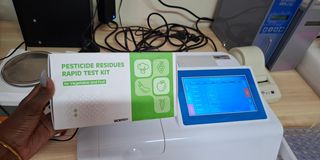
Rapid testing kits for pesticides to expand surveillance to markets and hotels.

Two years after Nakuru County established a food safety laboratory to strengthen surveillance of food products, testing has revealed worrying levels of aflatoxin contamination in cereals and milk, even as most samples tested for pesticide residues have met the required standards.
The laboratory, launched in 2024, has analyzed 670 cereal samples for aflatoxins, with 25 per cent recording levels above the recommended limits.
It has also tested 42 milk samples, about 10 of which were found to contain elevated levels of aflatoxin M1, a toxin produced by certain moulds that can contaminate milk when dairy animals consume contaminated feed.

A further 91 samples tested for pesticide residues recorded a 90 per cent compliance rate.
Kinyanjui Mugwanja, the public health officer in charge of food safety in the county and coordinator of the laboratory services, says the findings have helped strengthen the county's ability to identify potentially unsafe food before it reaches consumers.
He says the laboratory tests for aflatoxins in cereals and milk, pesticide residues, as well as milk quality to establish whether it has been adulterated through the addition of water or preservatives such as hydrogen peroxide.
"Since we launched the lab, we have been able to analyze 670 samples for aflatoxin, and of these, 25 per cent had levels higher than recommended," he says.
The laboratory also supports food safety surveillance beyond routine testing, with the county now working with the Department of Agriculture to collect samples from farms supplying produce to local markets.
The ongoing exercise involves testing fruits and vegetables for pesticide residues, as well as assessing the quality of water used for irrigation.
Mugwanja says the county has also procured rapid testing kits that will allow public health officers to conduct checks in markets and hotels to establish whether produce sold to consumers complies with pesticide residue standards.
The county has also procured rapid testing kits for pesticides to expand surveillance to markets and hotels. Mugwanja says the kits will enable public health officers to check fruits and vegetables sold in eateries and establish whether they comply with the required pesticide residue standards.
"That means we will be going around our markets and hotels to ascertain that the fruits and vegetables being sold in our eateries are compliant with the standards as far as pesticide residues are concerned," he says.
Where food is found to be non-compliant, he says, the county takes action to have it removed from the market and conducts awareness campaigns to encourage institutions to submit food samples for testing before making bulk purchases.
Patricia Wasuna, GAIN's communications coordinator, says the organization has trained public health officers on food safety and food fortification to help them identify violations during routine inspections and surveillance.
"We have also trained public health officers on food safety. This has been crucial because when they go out to conduct surveillance, they are able to know what to look out for in terms of food safety and food fortification to ensure compliance," she says.

Through the CASCADE Project, GAIN has also advocated for dedicated laboratory personnel to receive and process samples, reducing delays in testing.
Wasuna says the organization has also worked with the Department of Education to disseminate school meals food safety and quality guidelines, encouraging schools to submit food samples for testing before making bulk purchases.
"Since they do mass procurement, they are able to connect with the laboratory and bring samples for testing. This has really improved the quality of food and also its safety in terms of what schoolchildren are consuming," she says.
However, despite the progress, the laboratory faces operational challenges that could affect its ability to sustain testing.
Mugwanja says inadequate resources sometimes leave the facility without essential reagents for a month or two, interrupting testing activities.
The county is also working towards accreditation of the laboratory, a process that would strengthen recognition of its test results.
Currently, samples found to have contamination levels above the recommended limits are referred to the National Public Health Laboratory for confirmation before further action is taken.
"We are working towards accreditation so that our results can be established. When we find a sample with high levels, we take it to our mother laboratory, the National Public Health Laboratory, for confirmation," he says.
He adds that the results obtained from the national laboratory have generally been consistent with the county laboratory's findings.
Although the county has not yet analyzed its results by sub-county to establish geographical patterns of contamination, Mugwanja says testing has identified areas with elevated aflatoxin levels and others where pesticide misuse has been observed.