Donkeys of war: Bearing Nessuit’s burden
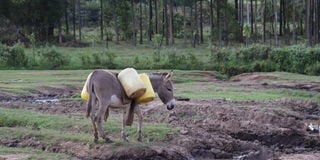
A donkey walks towards a puddle of water for a drink in Nessuit on November 25,2025. The donkeys play a key role during conflict.

We meet Wambui grazing on a lush green field next to a stream. Our presence makes her pause for a few seconds to look at the intruding guests, before continuing with her feeding.
While many just see a donkey like any other, to Monica Chepkurui, Wambui is a companion, a helper and a great support in times of war.
Having lived in Nessuit, Njoro sub county for 10 years, Chepkurui has unfortunately been caught up in the skirmishes that have been witnessed from time to time.


She vividly remembers the incident in 2024 where tensions arose between two communities triggered by boundary disputes.
“It was in October one night when we heard loud screams. When I went outside to investigate, I saw smoke billowing in the air from houses that had been torched,” Chepkurui narrates.
Alarmed, she and her family left the home in fear of being burnt inside and slept in the fields.
When day came, Chepkurui joined other neighbours to move to safety. It was Wambui and her 3 other donkeys who helped her carry her bedding, clothes and even chicken.
“We sought refuge at Nessuit primary school. Once we were settled, I lent Wambui and the other donkeys to my neighbours who did not have a way of carrying their belongings,” she continues, visibly shaken by the memories.
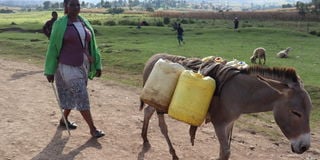
Monica Chepkurui guides her donkey 'Wambui' back to the house after fetching water from the river in Nessuit on November 25,2025.
Asked if she charged her neighbours for this service, Chepkurui shakes her head and insists it was just a way of helping each other.
But carrying belongings is not the only thing the donkeys of Nessuit do.
Chepkurui says the donkeys are also used to bring food aid to the camp since motorists are too afraid to drive into the area.
“Before the government brought us food, the donkeys were used to bring food aid from Njoro town to the camp. I don’t know what we would do without them,” she recalls fondly.
Her account is similar to that of Bornes Mitei who has lived in Nessuit for 15 years.
Mitei too had 3 donkeys who helped her carry her belongings and that of her neighbours to safety.
“I joined other residents at Nessuit primary. I remember we had to stay in the school for 2 weeks. The tension was so high, all we cared about was staying alive,” she recalls.
Amidst the skirmishes, Mitei says her donkeys were stolen.
She however managed to replace them with three others which she fondly named Wanjiru, Toto (little girl) and Kijana (young man).
To understand the impact of losing the donkeys, one must go back to the beginning, when Mitei first came to Nessuit.
“When I came here, I did not have a donkey. I did casual jobs like farming and was paid per foot. It was hard labour so I worked hard and got myself a donkey.
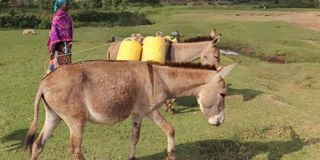
Bornes Mitei guides her donkey 'Wanjiru' to the river where they fetch water for use in Nessuit, on 25th November 2025.
She continues, “With this, I was able to carry firewood from the forest and sell it for sh 500. With 3 donkeys I made sh 1500 per day. Therefore, losing them meant my source of livelihood was gone,” she explains, sadness painted on her face.
For Chepkurui, she does not want to imagine life without Kijana (young man), Wambui, Kuchur (one with a cut ear) and Merebu (the tall one).
Next to protecting her life and that of her family, she says she kept a close eye on her donkeys every day she stayed in the school.
“They grazed right here where I could see them. The school built a trough and I was able to give them water. When we slept I made sure they were well secured. It would be heartbreaking if they were stolen,” she says, wishing the bad image away.
Chepkurui adds that she uses the donkeys to carry water which she sells for Sh 20 a barrel at Nessuit centre. Each donkey carries 4 barrels.
“I am able to pay school fees because of the money I make from the donkeys. Losing them during clashes would be devastating and would set my family back significantly,” she says looking fondly at Wambui.
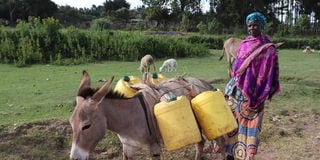
Bornes Mitei poses with her donkey 'Wanjiru' after an interview with Mtaa Wangu on November 25,2025
Richard Molel, another resident who has been in Nessuit for 10 years says they have noticed cases of donkey theft increase during the clashes.
“People take advantage of the skirmishes to make away with the donkeys. It is not just the cows and sheep that are at risk,” he reveals.
To protect them, Molel says residents were forced to put them inside a store or build a shed similar to that of a cow just to keep them safe.
A donkey he says goes for about Sh 10,000 to Sh 15,000 depending on the size.
And as for Gideon Bett who has lived in Nessuit for 7 years, he too used the donkeys to carry his belongings and that of his neighbour to safety.
Bett has two donkeys, fondly named Kipsalat (black one) and Chelel (white one) who he speaks so fondly of.
“The two donkeys are my lifeline. I make Sh 1,000 per trip carrying firewood from the forest. I don’t want to imagine what would happen if they were stolen or hurt during the clashes,” he says.
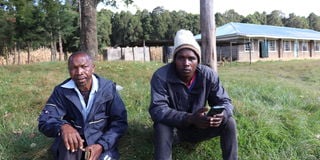
Richard Molel (left) and Gideon Bett pose for a photo after an interview with Mtaa Wangu in Nessuit on November 25,2025.
According to Kenneth Wamuga, the Executive Director Farming Systems Kenya (FSK), sometimes when skirmishes occur, it opens doors for donkeys to be stolen, either for beef or illegal skin trade.
“Farmers with donkeys are sitting on a gold mine because of how the prices have gone up owing to the illegal skin trade,” he affirms.
Wamuga further explains that away from being stolen, the donkeys also suffer in instances of war when they are abandoned in the homes amidst the chaos therefore left without food, water or vet care.
“Often time the farmers will carry the cows, chicken and other pets to safety and abandon the donkey. This opens an opportunity to be hurt, starve and even die if left alone for long periods,” he says.
To reduce these chances, Wamuga says FSK is constantly explaining to farmers how to take care of their donkeys, by highlighting the value the animal has to them in times of disturbance.
“We sensitize farmers on vet care, hoof care, time to rest, hydration, deworming as well as ectoparasite control. All these help to give the donkey overall quality health,” he adds.
At the same time Wamuga says FSK shows farmers the best material to place on the animal before making it carry water or firewood to reduce wounds on it.
However, on instances of malicious cuts or other injuries, FSK works with local service providers to care for the animals. In extreme cases, the animal is euthanized if the wound is terminal.

Bornes Mitei puts a blanket on her donkey 'Wanjiru' to protect the skin from damage before placing water barrels on the animal. Photo taken on November 25,2025.
In an interview with Mtaa Wangu, Njoro Deputy County Commissioner (DCC) Mokin Ptang’uny confirms that while disturbance may have triggered donkey theft in previous years, 2025 has seen a particularly calm year for Nessuit, and in turn a good year for the animals.
“We did not witness clashes this year thus I have not received any case of donkey theft. We hope things remain the same next year,” Ptang’uny adds.
In other parts of the country, donkeys have been caught in the crossfire during conflict. For instance, in 2024, it was widely reported that a donkey cart laden with explosives blew up in Mandera county, killing five people.
In January of that same year, an improvised bomb blew up at a checkpoint along the Kenyan-Somalia border killing one police officer.
This use of donkeys was said to make the war against terrorism ‘complex’.
In countries like Sudan, donkeys have been said to be the main source of transport in El-Fasher as residents escaped to safety in Tawila in September this year, according to an article by The Guardian.
And in July 2025, an article on the truth stated that donkeys had remained the only source of transport in Gaza, after fuel prices soared and many vehicles were left destroyed due to the bombing.
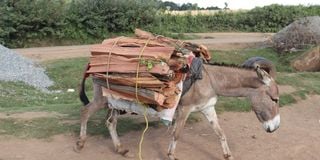
A donkey ferrys firewood from the forest to the household in Nessuit on 25th November, 2025. The load costs sh 500.
Here, donkeys were even used as ambulances, ferrying the injured to medical camps.
According to a post on Brooke East Africa website, an organisation formed to care for equine animals after world war one, working animals have always been lifelines.
“In the First and Second World Wars, horses and donkeys carried food, ammunition and the injured through unimaginable conditions,” the post reads in part.
The post further states that, “Across regions facing crisis or instability, horses, donkeys and mules continue to transport food, water, and vital supplies. For many families, they remain the difference between survival and despair.”