Visoi farmers embrace project to rehabilitate 3700 acres of degraded lands
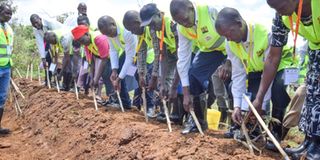
Residents from Visoi Ward plant Napier Grass on the demonstration site on fro the retention ditches

Residents of Visoi Ward in Rongai Sub-County have long struggled with severe land degradation, which has steadily eroded their agricultural productivity and economic stability.
The degradation, largely caused by poor land management practices and uncontrolled water flow, has left many farms waterlogged and unproductive, making it difficult for farmers to sustain their livelihoods.
For many households in the area, farming is the primary source of income. However, as land conditions worsened, crop production significantly declined.

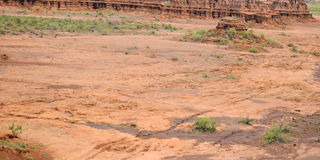
A photo of the degraded land in Visoi Ward
Alice Rono, a resident of Visoi Ward, recalls how excess water once dominated a neighbour's farmland, making it nearly impossible to cultivate crops.
“Our land used to be waterlogged, making it difficult for us to use it effectively for farming,” she explains. “Whenever it rained, water would accumulate on the land instead of draining away, leaving the soil too saturated for productive agriculture.”
As a result, many farmers in the area have struggled to generate income from their land. The degraded condition of the soil has not only reduced farm yields but has also affected the value of land in the region.
She adds that poor land management practices, such as farming on steep slopes without terraces, have further accelerated soil erosion, while uncontrolled surface runoff during heavy rains has washed away the topsoil.
According to Daniel Kiptanui, some residents have been unable to sell their land because potential buyers are discouraged by its poor condition.
He notes that the degradation has affected several villages, including Legetio, Kapkatet, and Magare. He explains that the affected land has gradually become less productive, forcing farmers to seek solutions that can restore its value and productivity.
“Many farmers depend on this land for their livelihood, but the poor condition has made it difficult for them to benefit from it economically,” he says. “If the land remains degraded, farmers cannot farm effectively and even selling the land becomes a challenge.”
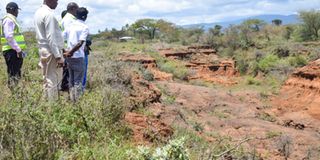
Nakuru County Agriculture CECM Leonard Bor assess the magnetic of soil degradation in Visoi Ward
Additionally, the clearing of vegetation and trees to create more farmland has left the soil exposed to erosion by water.
"Overgrazing by livestock has also weakened the soil structure and reduced vegetation cover, making the land more vulnerable to degradation and waterlogging," he notes
Despite these challenges, hope is emerging through a new initiative aimed at rehabilitating the Lengenet Watershed, which drains into the larger Molo River. The project focuses on restoring degraded land through sustainable land management practices while strengthening the community’s ability to adapt to environmental challenges.
Youth in the area are also playing a key role in the restoration efforts. Irene Misoi, one of 15 young people trained under the project, says the initiative has equipped them with skills to support their families and improve farming practices.
Through the project, young people are helping farmers construct terraces and farm ponds, which will help control water flow and improve soil conservation.
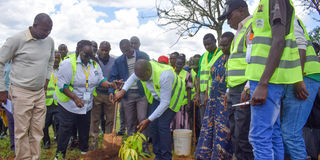
Nakuru County Agriculture CECM Leonard Bor assess the magnetic of soil degradation in Visoi Ward
The project aims to rehabilitate 3,706 acres of land while increasing vegetation cover through reseeding and tree planting. Plans are also underway to plant 3,500 high-value mango fruit trees and 1,750 Casuarina forest trees, alongside expanding vegetation cover across 150 hectares of degraded land.
Additionally, the initiative will enhance water harvesting through the excavation of 12 farm ponds, each capable of holding 300 cubic meters of water. Other interventions include the construction of terraces, retention ditches and cut-off drains to prevent soil erosion.
County Agriculture Executive Committee Member Leonard Bor emphasized that the initiative will help restore both the environment and farmers’ livelihoods.
“This project is not just about conserving the watershed but also about empowering farmers with sustainable practices that will increase productivity while protecting natural resources,” he says.