KALRO’s new shelling machine set to boost groundnut production in Rongai
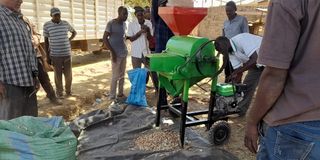
The ground nuts shelling machine by KALRO during testing in Rongai

Hand shelling groundnuts, a traditional practice common among smallholder farmers, remains one of the most time-consuming and labor-intensive stages of groundnut production.
The method, which involves cracking individual pods between the thumb and forefinger, yields only about 7–10 kilograms per day, making it inefficient and costly for farmers seeking to produce at scale.
In Majani Mingi, Rongai Sub-county, groundnut farmers are now expressing hope following the introduction of a prototype groundnut shelling machine developed by the Kenya Agricultural and Livestock Research Organisation (KALRO).

Samuel Ng'etich a groundnut farmer who began groundnut farming last year, has faced the challenge of shelling, which has been a major setback.
“I started groundnut farming last year, together with some group members but one of the biggest challenges we faced was shelling,” the farmer explains. “The machine is expensive, so when we heard that there was someone who had one, it was a big relief to us. We would really love to be helped with the machine if it is possible.”
Like many farmers in the area, harvesting and shelling are done manually. “We use our hands,” Ng'etich says, adding that filling one sack can take a long time. “It takes about one month for a sack to be full, but if you have many, it takes less time.”
He says that the slow process has financial implications. “It costs us financially because you have to incur labour costs all the time,” he notes. “It also affects us when it comes to selling. When a buyer comes and finds you only have a small amount, yet they want large quantities, in the long run we end up losing money.”
Most farmers in Majani Mingi cultivate groundnuts on relatively small parcels of land, averaging between one and two acres, making efficiency after harvest even more critical.
To address these challenges, KALRO has been working on a groundnut sheller prototype designed specifically to ease post-harvest handling.
Engineer Eliud Kizito from KALRO says that it is a simple machine which removes the outer husks of the groundnut, and in one hour, it can shell around two bags.
According to Kizito, the innovation responds directly to farmers’ concerns. “Most farmers still use their hands for manual peeling of groundnuts. There was a request from farmers asking to be helped, especially with post-harvest machinery, because shelling was one of the biggest challenges they were facing,” he says. “That is why we decided to design this machine, to ease the shelling process.”
The machine runs on a small 1.5-horsepower engine powered by a generator and consumes about two litres of fuel per day. With those two litres, a farmer can shell up to 10 bags in a day, highlighting its potential to significantly reduce labour and time.
On efficiency, Kizito acknowledged that testing is still ongoing. “We are still working on it, and that is why we were doing trials in Rongai. We have not finished the validation to get the final percentage,” he says.
However, early results are promising. “What I know is that the breakages are around five per cent, which means the efficiency is about 95 per cent for dehusking.”
The sheller can handle different groundnut varieties and sizes through adjustable settings. “Groundnuts come in different sizes, small, medium, and large,” Kizito explains. “What we do is adjust the sieves and the rollers that break the husks. It is just a matter of playing with the sieves according to the size of the groundnut.”
While the machine is still a prototype, Kizito remains optimistic. “It is still under development, and validation has not been done properly yet,” he says.
For farmers in Rongai, however, even this early-stage innovation represents a step toward reducing losses, cutting costs, and improving access to markets through increased volumes, offering renewed hope for the future of groundnut farming in the area.