Potato prices skyrocket in Nakuru amid shortage
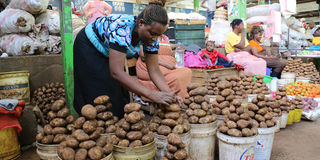
A trader stacking potatoes at Nakuru Wakulima Market.

A few weeks ago, there wasn’t any milk, and now consumers need to brace for impact because it is also happening with cash crop ya Nyandarua.
Potatoes for most households are beloved, but Nakuru farmers and traders are sounding a different warning even as we head into the festivities.
The county’s billion dollar generating crop has become scarce and currently costs an arm and a leg.

In parts of Kuresoi, Lex Sang' says the crop now goes for Sh 4,000 and Sh 5,000 for a 70kg bag; the same bag would typically fetch about Sh 2,000 to Sh 2,500.
“Potatoes are now very expensive,” he says. “The July-August drought is the cause of all our woes, which was followed by frost that damaged, wiping out a good chunk of the expected harvest.”
Lex says the problem is particularly pronounced in Kuresoi and has also had counterparts in Marioshoni complain of the same.

KASA Vice Chair, John Katana, inspects a potato farm in Njoro
The latest National Potato Council of Kenya figures put ware potatoes in Nakuru at about Sh 71 a kg on September 15, compared with Sh 58-64 in Nairobi and Sh 66 in Eldoret.
For chips lovers, Joyce Wanjiku Kamau says consumers will need to lessen their appetite as they can’t serve the same quantities as compared to when there’s a glut.
“The economy is currently biting everyone, and the scarcity of potatoes is not helping. We are only able to sell a plate of chips for the same prices, between Sh. 80 and 100, but with lesser quantities to not chase our customers and to keep up with the competition,” says the city market-based trader.
She notes that even getting the potatoes has been a problem; this has been happening since the end of August.
“Even with the shortage, the potatoes we’re getting are not good. We’re getting very small sizes which we’d normally not use to fry chips, but we just buy them regardless,” she says
The price hit seems to have affected everyone in the value chain, with Wanjiku noting they’re currently buying a bag that holds about five debes at Sh. 6,000, up from about Sh. 3,800-4,000
She says she’s also been forced to buy potatoes directly from the market as opposed to her usual farmers in Mauche or Mau Narok because the said farmers have no stock, but traders are able to go for potatoes as far as parts of Tanzania.
While reiterating the issues mentioned as the cause of the potato drought, Wanjiku says farmers also lamented a period of too much rainfall which caused the crop to spoil.
“We are currently not doing well economically, and if this continues, consumers should brace for an extreme potato drought if things don’t change soon,” she says.
She adds that it’s gotten worse that sometimes they don’t get potatoes at the market, which forces them to close shop.
A sack that they’d sell in a day when business was good; now Wanjiku notes that it takes them about four to five days to run through the same sack, which while accounting for other resources used in the business, still makes them wallow in losses.