Why Nakuru households are skipping tomatoes in meals
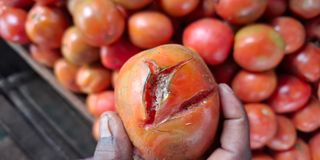
A trader at Wakulima Market displaying a tomato with a fruit Salk

‘Eloi, Eloi, huku chini si kurahisi sababu hatufikii bei ya nyanya’
By now, you have already seen the numerous memes about the unaffordability of the basic commodity that graces almost every meal in your kitchens
The jokes have been flying with one meme making rounds with one noting “Sai mama mboga akiblink kimakosa, nyanya tatu zinaingia kwa mfuko.”

Another one quips that “nyanya inauza kama GLE itabidi kitunguu ikubali kuwa single parent in my menu.”
These and many more statements are flying around the internet, but beneath the humor, the numbers are outrageous, and Mtaa Wangu made a spot check at Nakuru’s Wakulima Market to find out why.
Traders note that despite the rains, which we now have in plenty, this has been the biggest hiccup affecting prices.
“Tomatoes don’t often require too much rain, and with it comes a series of problems from the farm to the market,” says one trader, adding that many times rain hinders transportation as roads get cut off.
Currently, as of April 29, a crate of small tomatoes that weighs about 80kgs was going for about Sh 7,000, but a trader confirmed that in March she sold the same at Sh 1,000.
A crate of medium-sized to large-sized tomatoes, and depending on the grade, was going at an upward of Sh 8,500.
A 10kg bucket that went for Sh 500 yesterday was an upward of Sh 1,300, with smaller quantities like the 5kg kasuku (tin) hovering around Sh 300, up from Sh 100 to 150 not long ago.
More than 20 tomatoes that would go for about Sh 100, yesterday only 7 were going for the same price.
Traders add that the excess rainfall in key growing counties, particularly Baringo and Laikipia, has devastated the crop, with many arriving at the market with disease spreading fast due to cold, while others are just bursting around the Pedicel (Fruit Stalk) area.
“It will take farmers a lot of pesticides to manage the cold, which means the price increase will trickle down to the consumer,” a trader notes, adding that tomatoes coming from the farm right now are less than the required (optimum) quantity, whereas there are a lot of traders.
The traders presume that this will go on for a while until prices stabilize.
For now, itabidii mmekaza mshipi na mununue nyanya bei ya nyumba yangu haina mlango (yai).