New potato seed technology promises higher yields for Nakuru farmers
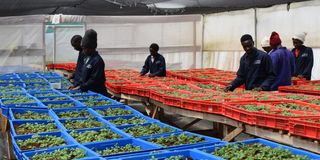
Inside the Rooted Apical Cuttings (RACs) multiplication greenhouse in Keringet Sub-county

For Ann Macharia, a potato farmer from Muchorwe, adopting new seed technology has marked a significant turning point in her farming journey, which began in 1997.
For many years, Ann relied on recycling potato seeds, often sharing and exchanging planting materials with her neighbours.
However, the practice came with challenges, including declining productivity and the risk of carrying diseases from one planting season to another.

That changed when she adopted Rooted Apical Cuttings (RACs), a technology that has significantly increased her potato production and improved her farming experience.
Ann says the technology has not only boosted her harvests but also encouraged other farmers in her neighbourhood to embrace the new planting material after witnessing the results on her farm.
She notes that the cuttings offer an added advantage because of their improved resistance to diseases, making them a promising alternative to the traditional practice of recycling potato seeds.
Her experience reflects the growing interest among farmers in adopting improved seed technologies to enhance productivity, reduce crop losses and strengthen potato production.
The technology is being supported through efforts by FIPS Africa, which is investing in the production and distribution of quality potato planting materials to improve farmers' access to reliable seeds.
According to Raymond Allan Kojo, Partnerships and Technical Manager at FIPS Africa, the organisation established its greenhouse facility in Keringet, Nakuru County, in 2023 as part of efforts to strengthen access to quality seed potatoes through Rooted Apical Cuttings (RACs).
“Since its establishment, the facility has cumulatively produced approximately 2.5 million planting materials, contributing to improved access to quality seeds among potato farmers,” he notes.

Potato field in Muchorwe, Molo Sub-countY
Kojo says the organisation currently operates two greenhouses at Keringet, with a combined annual production capacity of approximately 1.6 million rooted apical cuttings.
Beyond seed production, the facility has also contributed to local employment, directly creating 15 job opportunities while supporting skills development and livelihoods within the community.
“We have reached approximately 103,000 farmers, helping them access quality planting materials and improve productivity across the potato value chain in four sub-counties including Njoro, Molo, Kuresoi South and Kuresoi North sub counties,” he says.
He highlights that the next phase of expansion will focus on establishing decentralised greenhouse facilities to bring seed production closer to farmers and improve access to planting materials.
“We hope to extend operations to Bahati and Subukia sub-counties, increasing the reach through Village-Based Advisors (VBAs).The initiative targets a total of 600 VBAs across Nakuru, with each supporting approximately 300 farmers through the distribution of small packs containing 50 rooted apical cuttings, alongside extension services and linkages to agricultural support systems,” he highlights.
Kojo notes that decentralising production will make the seed distribution system more accessible and responsive to farmers' needs while strengthening the sustainability of the potato seed value chain.