Nakuru hosts World Potato Congress

Mutahi Kagwe addresses delegates at the World Potato Congress in Naivasha.

Nakuru County’s role in Kenya’s potato industry has placed it at the centre of international discussions on food production, markets and agricultural innovation as the 13th World Potato Congress takes place in Naivasha, bringing together stakeholders from across the global potato value chain.
Cabinet Secretary for Agriculture and Livestock Development Mutahi Kagwe officiated the opening of the congress, which has drawn delegates from different countries to discuss how the potato industry can respond to changing food demands, production challenges and emerging market opportunities.
Kagwe highlighted the significance of the gathering in connecting Kenya’s agricultural sector with international expertise, research and investment.

"The congress provides an opportunity for stakeholders to examine challenges affecting potato production while exploring ways to improve productivity, processing and trade," he says.
Nakuru’s selection as host county reflects its position in Kenya’s potato economy. The county contributes more than 15 per cent of national potato production, with approximately 657,091 metric tonnes produced and over 150,000 farming households depending on the crop for their livelihoods.
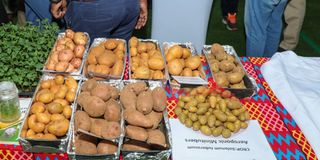
Some of the potato seeds displayed at the World Potato Congress in Naivasha
Nakuru County Deputy Governor H.E David Kones says the scale of production has not eliminated the challenges facing farmers.
"Access to certified seeds remains a concern, while pests and diseases, unpredictable weather, high input costs and unstable markets continue to affect production and earnings," he notes.
Additionally, he notes inadequate storage facilities and post-harvest losses mean that increased harvests do not always translate into better returns for farmers. These concerns are likely to remain central to discussions on how the sector can become more competitive.
The congress theme, Global Potato Partnership for Enhanced Food Systems, Nutrition Security and Trade, places emphasis on collaboration across research, production and markets. Discussions are expected to cover improved potato varieties, crop protection, climate-smart agriculture, mechanisation, processing and investment.
For Nakuru, the gathering also presents an opportunity to draw attention to the needs of farmers who supply both domestic and commercial markets. Better access to quality planting materials, extension services and reliable markets could help address some of the longstanding production and marketing difficulties.
The five-day congress will also extend beyond conference discussions to practical farming demonstrations, giving participants an opportunity to examine potato varieties, crop management practices and mechanisation at Fresh Crop in Mau Narok, Njoro Sub-county.