How training on sustainable farming changed fortunes for indigenous vegetable farmers in Kuresoi
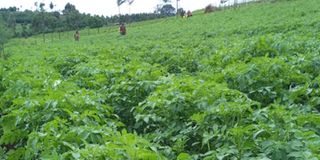
Chesubeno Self Help Group Potato farm project started from the proceeds of selling the green leafy vegetables.

What began as a table banking initiative in 2018 has grown into a model of community-driven transformation for the Chesubeno Umoja Self Help Group, thanks to targeted training on nutrition and sustainable farming through the Farmer Field and Business School.
Led by chairperson Joseph Rono, the group of 26 members initially focused on pooling savings and supporting one member at a time. However, their journey took a new direction when they were introduced to the Farmer Field and Business School, a program designed to equip farmers with practical skills in agriculture and nutrition.
“We received support with indigenous vegetable seeds, but first we needed to identify land where we could get trained,” recalls Rono.


Chesubeno Self Help Group chairperson Joseph Rono.
This marked the beginning of a hands-on learning experience that would reshape the group’s approach to food production and consumption.
He notes that the training emphasized the full farming cycle from land preparation to harvest.
"Members learned the importance of assessing land size to determine seed requirements, preparing organic compost manure to enrich soil fertility, and planting certified seeds. The focus on organic practices ensured that the crops were both nutritious and safe for consumption," he says
Initially, the group farmed collectively, growing indigenous vegetables such as managu (African nightshade). The first harvest was a turning point.
“We realized it was not stressful to grow these crops,” says Rono. Encouraged by the results, members began cultivating vegetables on their individual farms.
One enterprising member took up the role of aggregating and selling the produce, creating a small but effective value chain within the group.
As confidence and capacity grew, the group expanded its activities. They acquired a three-acre piece of land where they began farming potatoes, further diversifying their income sources.
The impact of the training has been significant. According to Rono, members are now experiencing improved health and economic stability.
“There is a big change. Families are eating better, children are healthier and are attending school regularly. Cases of members lacking school fees have reduced, and when challenges arise, we support each other through the group kitty,” he explains.
Beyond income, the training has reshaped dietary habits. Previously, members consumed vegetables without being aware of the potential health risks associated with chemical use.
Now, with knowledge of organic farming and nutrition, there is a growing preference for indigenous vegetables like managu.
“People are now choosing managu over sukuma wiki and incorporating it more into their meals,” Rono notes.
The initiative has also attracted the interest of young people, many of whom form a significant portion of the group’s membership. The combination of practical skills, income opportunities, and improved nutrition has made agriculture more appealing to the youth.
Through the Catalyzing Strengthened Policy Action for Healthy Diets and Resilience (CASCADE) project, the Farmer Field and Business School continues to empower communities like Chesubeno Umoja, demonstrating how integrated training in agriculture and nutrition can drive lasting change at the household level.