Vetting of Persons Living with Disability eligible for income tax exemption to begin in Nakuru
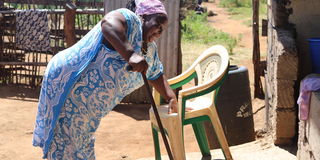
Elizabeth Auma uses a chair and walking stick to help her move about her home.

The government is set to begin the process of vetting of persons living with disability eligible for income tax exemption in Nakuru
The exercise which targets new applicants and those seeking to renew their certificates will be conducted at Nakuru County Teaching and Referral Hospital on August 21 and 22 from 8 am to 12 pm.
Isaac Rugito, the Chief Disability Services Officer in charge of the Rift Valley region, says the exercise is conducted to determine which applicants qualify for the income tax exemption.
The exemption applies to the first Sh150,000 of monthly income, according to the Kenya Revenue Authority.

“If you are earning more than Sh150,000, the surplus, say Sh160,000, then Sh10,000 on top of Sh150,000 will be subjected to tax,” Rugito says.
This means the exemption does not wipe out tax obligations on income above the exempted threshold.
He adds that the exemption is linked to income and is not limited to salaries from formal employment and that people earning taxable income through self-employment, businesses and other forms of income can also apply, provided they meet the eligibility requirements.
The income tax exemption should not be confused with an exemption from every statutory deduction.
Rugito says the benefit applies specifically to income tax and that other statutory deductions must be paid.
Applicants must be persons with disabilities who have the required disability certification and earn income that is subject to tax and is not restricted to people in a particular age group or to one type of disability.
“As long as you are a person with a disability, with a certificate, and you are employed, you are included,” he says.
KRA’s current requirements include a disability assessment report from a government gazetted hospital, registration with the National Council for Persons with Disabilities, proof of taxable income and successful vetting by a joint committee involving NCPWD, the Ministry of Health and KRA.
Rugito says the vetting is conducted in collaboration with the Kenya Revenue Authority and the Ministry of Health.
He explains that the Ministry of Health provides the guidelines used to determine the threshold for eligibility, while KRA issues the exemption certificates, and the council facilitates the process and plays an oversight role to ensure that eligible persons with disabilities are considered for the exemption.
The exercise is open to both first-time applicants and people seeking to renew their exemption certificates.
Rugito says renewals are done after five years.
Applicants are required to submit their applications through the eCitizen platform before appearing for physical vetting.
Applicants are required to carry all the original documents they uploaded when making their applications.
For people with acquired disabilities, the Council says applicants must have a specialist report from a government hospital.
The Council has also cautioned applicants that the vetting process is free of charge and the only payment required is the application fee payable through the eCitizen platform.
Rugito says the application and vetting process is conducted quarterly, with exercises held during each of the four quarters of the financial year.
This means new applicants and those seeking renewal can apply during the designated vetting periods.