UDA bets on development projects as battle for Nakuru voting bloc heats up
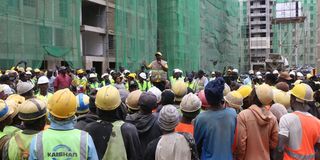
Deputy President Prof. Kithure Kindiki in Bahati on October 27 joined by area MP Irene Njoki where he inspected development projects including affordable housing and modern market in the constituency
Nakuru County is emerging as a key political battleground ahead of the 2027 General Election, with the government banking on its development record to consolidate support while opposition leaders, led by the Democracy for the Citizens Party (DCP) through its leadership, Rigathi Gachagua and Linda Mwananchi movement under Edwin Sifuna, seek to unite voters around unmet promises, key political blocks and demands for accountability.
The contest for political influence played out in Njoro and Bahati today, where Deputy President Prof Kithure Kindiki toured the two constituencies to inspect ongoing development projects and highlight the government's investment in Nakuru as opposition leaders continue to build alliances and challenge the administration's record ahead of the 2027 polls.
Nakuru's political significance lies partly in its position within the broader Mt Kenya political landscape, commonly referred to as the "Murima bloc", and its potential influence on the presidential contest.

Opposition leaders, through political mobilisation and alliance-building, hopes to turn public concerns over the delivery of campaign promises into a broader challenge to President William Ruto's re-election bid.
On the other hand, the government is intensifying its presence in the county, highlighting ongoing projects and promising equitable development as it seeks to convince residents that its development agenda is delivering tangible results.
During his tour in Njoro and Bahati, Prof. Kindiki maintained that the government was committed to equitable development, saying no region or community would be left behind.

Deputy President Prof. Kithure Kindiki in Bahati on October 27 where he inspected development projects including affordable housing and modern market in the constituency
Anchoring his message on the slogan “Usawa ni Sawa,” the Deputy President said the administration was pursuing development without discrimination, pointing to ongoing infrastructure and market projects as evidence of its commitment.
Prof Kindiki inspected the Njoro-Beeston-Lawina-Elburgon Road, which is being constructed at a cost of Sh 2 billion, as well as the Nesuit modern market in Njoro, which was reported to be 99 percent completion rate at a cost of Sh 55 million.
He also outlined the government's plans for the Rironi-Mau Summit highway project, saying the Limuru-Naivasha section was expected to be completed by December, with the remaining section targeted for completion by the following year's Mashujaa Day celebrations.
“We hope the national celebrations will be in Nakuru County, a move that would further place the region at the centre of the administration's development agenda,” Kindiki noted.
Kindiki cited the construction of 25 markets in Nakuru costing Sh 2.3 billion , with four additional markets in the pipeline, alongside electricity connectivity projects worth approximately Sh 3 billion across the county's constituencies.
Deputy President Prof. Kithure Kindiki in Bahati on October 27 joined by area MP Irene Njoki where he inspected development projects including affordable housing and modern market in the constituency
He also pointed to plans involving 870 kilometres of new roads, estimated at Sh 38 billion, as well as affordable housing projects intended to expand access to decent homes and stimulate economic activity.
The projects form part of the government's broader effort to demonstrate its development record as political competition for Nakuru's support gathers momentum.
However, the emerging political contest goes beyond project launches and inspection tours. While the government is seeking to persuade residents through infrastructure investments and promises of equitable development, opposition leaders are positioning themselves as an alternative, emphasizing accountability, unfulfilled commitments and the need for political change.
As the 2027 election approaches, Nakuru residents will ultimately have to weigh the government's development claims against their own experiences, including whether promised projects are completed, services improve and economic opportunities reach ordinary households (Common Mwananchi).