Nakuru launches agricultural extension policy to improve farmer advisory services
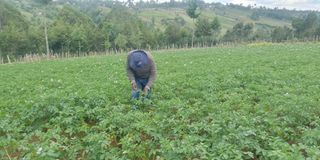
A farmer in a potato field in Kuresoi South Sub-county.

Nakuru County has launched its agricultural extension policy seeking to improve farmers’ access to agricultural information, coordinate advisory services and address a shortage of extension officers that has left many farmers without adequate support.
The policy seeks to bring together government extension officers, researchers, private sector players, farmer organizations and development partners to improve the delivery of agricultural information, including through digital platforms.
County Executive Committee Member for Agriculture Leonard Bor says the framework will help coordinate different stakeholders, who have previously used different approaches to delivering extension services.

“Extension is not a government’s job alone. It is a job of all stakeholders who are involved in agriculture,” he says.
Bor notes that without a coordinated framework, stakeholders risk working independently, duplicating interventions and wasting resources that could otherwise be directed towards farmers.
The policy is expected to strengthen access to information on crop production, livestock management, farm inputs, fertilizers, markets and value addition, while guiding the county's allocation of resources towards extension services.
Its introduction comes against the backdrop of a significant shortage of agricultural extension officers.
Nakuru County's 2026/27 Annual Development Plan lists 260,000 registered farmers against 297 extension officers, translating to approximately 875 farmers per officer.
This is above the 1:600 extension officer-to-farmer ratio targeted by Kenya's Agriculture Sector Transformation and Growth Strategy, and further above the Food and Agriculture Organization’s (FAO) recommended ratio of one extension officer for every 400 farmers. Nationally, the situation has been worse, with some areas experiencing ratios of up to 5,000 farmers per extension officer.
Bor says the county has made progress in addressing the shortage, having recruited an additional 100 extension officers, but more personnel are still needed to improve coverage.
“We can still do more to increase our extension officers so that the coverage at least reduces and the gap also reduces,” he says.
Beyond physical visits, the policy also seeks to strengthen technology-driven agricultural advisory services.
The county established Kenya's first farmer call center at the Agricultural Training Centre in March 2018, enabling farmers to seek advice from agricultural experts through phone calls, SMS, WhatsApp and other digital platforms.
The Nakuru Farmers Call Centre covers crops, livestock and fisheries, supplementing conventional extension services that have been constrained by limited personnel and resources.
Bor says the policy will help integrate the different digital platforms through which farmers access agricultural information, including the call centre.
“It is not only addressing production, it is also addressing the market,” he says, noting that farmers need information beyond how to grow crops, including where and how to sell their produce.
Kamau Stephen, a farmer from Kabatini Ward in Bahati, says the framework will help farmers improve their agricultural practices and get better value from their investments.
“The farmers will get value for their money. The farmers will be able to farm the way they do business without getting into trouble,” he says.
He adds that farmers will also benefit from learning from one another, improving how they use their land and adopt better farming practices.
Lina Cherono, a farmer and chairperson of the Community Development and Development Committee in Kamara Ward, says improved extension services could help farmers address diseases that have affected their farms and livestock.
“We used to lose a lot of livestock because of diseases before but I am thankful and happy because this extension policy has come in time to help us,” she says.
The policy also seeks to recognize farmers as contributors to agricultural knowledge, rather than merely recipients of information.
Daniel Wanjama of Seed Savers Network says farmer-to-farmer learning is an important part of extension, particularly where farmers have acquired practical knowledge through years of experience.
“We believe that if you are a farmer who has been farming and gaining experience, you are also an expert and can advise other farmers,” he says.