Indigenous farmers free to save, sell seeds after court strikes down punitive sections of Seed Law
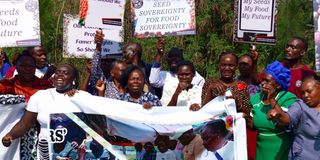
Organic/ Indigenous farmers in Gilgil celebrate the court's judgement on November 27 in Gilgil.

Indigenous farmers in Nakuru have welcomed the High Court decision quashing several sections of the Seeds and Plant Varieties Act, saying the ruling restores their freedom to save, exchange, and sell indigenous seeds without fear of criminalization.
The landmark judgment, delivered on November 27, nullified key punitive sections of the Seeds and Plant Varieties Act (Cap 326), which had previously criminalized the age-old and customary practice of saving, sharing, and exchanging uncertified or unregistered seeds by smallholder farmers.
The court found that these sections of the Act, which imposed heavy fines or jail terms on violators, were unconstitutional.
The judgment effectively decriminalized Farmer-Managed Seed Systems (FMSS) and restored the balance between the interests of commercial seed developers and the fundamental rights of farmers to their traditional seed practices, reaffirming that the sharing and saving of indigenous seeds are constitutionally protected.
The ruling is a huge victory for farmer-led seed systems that had come under pressure from tightened regulation.
Francis Ngiri, chairman of the Makongo Farmers Network that owns Eden Seed Bank in Gilgil, says the ruling renewed farmers’ confidence in the judiciary and affirmed their belief that collective action can defend their rights.
“We are pleased with the judgment. We expected to win, and this confirms that when farmers go to court to defend their rights, they can get justice,” he says.
Ngiri says the decision relieves farmers who had avoided openly sharing or promoting indigenous seeds for fear the law could be used against them. He says farmers can now expand seed production, strengthen biodiversity, and build local seed markets without worrying about penalties.
“Now we can promote our seed banks openly, even online or in the media. I can show what varieties I have without fear,” he says.
He adds that the next step is to increase indigenous seed production and strengthen farmer-led systems.
“What we want to do next is to prove that we deserve this judgment by producing even more seeds. Hybrid seed companies can continue selling their products if they wish, but our seeds also deserve space and recognition,” he says.
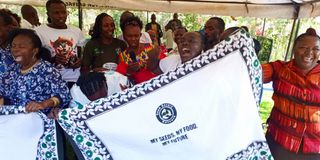
Organic/ Indigenous farmers in Gilgil celebrate the court's judgement on November 27 in Gilgil.
On her part, Martha Njenga, a farmer in Gilgil and TikTok creator who promotes organic farming, says she has spent years online advocating for indigenous seeds and was overjoyed when she heard farmers were finally free.
“I have been on the internet for a long time fighting for our seeds, and when I heard that we are free, I was very happy,” she says. “For the coming generation, they will know that the seeds belong to them.”
Njenga says the judgment gives her renewed motivation to educate farmers about indigenous varieties. She added that despite the old law, she never felt her advocacy was wrong. “Even though the law was punitive, I knew I wasn’t doing anything illegal. These seeds were left to us by our forefathers. Even if they arrested me, I would not have hidden,” she says.
Farmers say the ruling has given them new freedom and responsibility ahead of the planting season and hope the State will clarify how seed quality will be regulated without undermining the rights affirmed by the court.
The landmark High Court ruling has removed criminal penalties that once threatened farmers with up to 2 years in prison and fines of up to 1 million shillings for the traditional practice of saving, sharing, and trading native seeds.
For farmers in Nakuru and across Kenya, the decision marks the end of a regulatory framework that many felt favored corporate seed monopolies over local food security and cultural heritage