In Nakuru women form majority of employees but miss out in crucial leadership positions
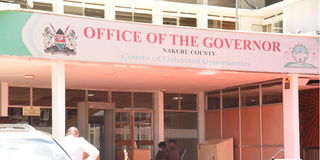
The office of the governor in Nakuru city.

Women form the majority of employees in the Nakuru County Government, but their representation in elected leadership positions remains considerably lower than that of men, according to the County Gender Data Sheet 2025.
The report shows that women account for 55.9 per cent of the county government's workforce, compared to 44.1 per cent for men. The figures reflect significant progress in promoting gender inclusion within public service employment and increasing women's participation in the formal workforce.
However, the gains recorded in employment have not been replicated in political leadership. The report indicates that men occupy 67.1 per cent of seats in the Nakuru County Assembly, while women hold only 32.9 per cent.

Beatrix Arusei, Program Officer at Midrift Hurinet, says the findings reveal a gap between women's participation in the workforce and their presence in decision-making positions.
"While the county government has employed a large number of women, most are excluded from political and decision-making positions. Historical inequalities, gender bias, limited access to leadership networks and workplace cultures that favour men create barriers for women's advancement," she says.
She notes a result, women may be well represented while remaining underrepresented in positions where important decisions, policies and resources are controlled.
Consequently, the findings highlight a persistent disparity between women's participation in the workplace and their representation in decision-making and governance structures.
At the same time, Nakuru recorded positive outcomes in the education sector. Female literacy stood at 96.8 per cent, slightly higher than the 95.2 per cent recorded among males. In addition, girls outperformed boys in secondary school attendance, with the county posting a gender parity index of 1.14 for net attendance, an indication that more girls than boys are enrolled and attending school.
Similarly, women in Nakuru demonstrated strong performance in financial inclusion indicators. According to the report, 82.5 per cent of women reported owning and using mobile phones, compared to 78.9 per cent of men. The county also surpassed the national average in women's mobile phone ownership, reflecting growing access to digital and financial services.
Nevertheless, challenges remain in household decision-making. The report reveals that only 68.3 per cent of women participated in major household purchase decisions, a figure that falls below the national average of 78.2 per cent.
Furthermore, women continue to bear the largest share of unpaid care and domestic responsibilities. On average, women spend 19.7 hours on unpaid domestic and care work, compared to just 3.5 hours for men.
Arusei notes that addressing the leadership gap will require deliberate efforts to challenge societal perceptions that associate leadership with men.
"This can be addressed by challenging norms and beliefs that make people believe leadership positions are a preserve of men. There is also a need to create fair and transparent promotion processes, ensure equal access to leadership positions based on merit and actively remove barriers that prevent women from advancing into decision-making roles," she says.
She further urges the county government to review its promotion and governance practices to enhance women's representation in leadership.
"The county government should set clear goals for gender inclusion in leadership and foster a culture where women's voices are valued and included in key decisions. If they genuinely believe women are capable enough to do the work, they should also trust them to help decide how the work gets done," she adds.
The County Gender Datasheets provide a harmonised evidence base for advancing gender equality and women’s empowerment under the Women Count Phase II strategy (2022–2025). Developed through a partnership between CoG, KNBS, SDGAAA and UN Women.