How drunk protestors blew cover for notorious illicit brew dealers in Rhonda
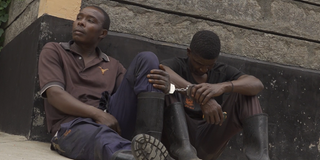
Two suspects of four arrested during the crackdown on an illegal alcohol manufacturing site in Rhonda, Nakuru West

Four people have been arrested and more than 6,000 litres of illicit alcohol confiscated from a single homestead in Rhonda, Nakuru West, during a crackdown targeting illegal brews.
The four suspects were arrested inside the compound where the illicit alcohol was being manufactured.
Nakuru County Commander Samuel Boit says the crackdown operation was launched following intelligence reports linking the area to the distribution of illegal alcohol within the county.

“We found that most of the demonstrators within our area of jurisdiction appeared to be under the influence of certain substances. We conducted analysis and gathered intelligence information, which yielded positive identification of what we had suspected,” says Boit.
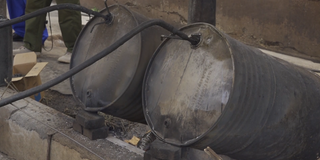
Distillation drums and pipes used in the manufacture of illicit chang’aa recovered during a police raid in Rhonda, Nakuru West
Boit notes that officers conducting operations in the area discovered an active chang’aa distillation site inside a house belonging to one James Karuko, alias “Karush.”
“We ended up at a house belonging to a gentleman known as James Karuko alias Karush, where our officers found a semi-industrial chang’aa distillation site. At the time of the operation, the distillation process was ongoing,” he says.
Boit says preliminary investigations have established that the operation was one of the main supply points for illicit alcohol within Nakuru County.
“We have come to establish that this is one of the main suppliers of illegal brews within Nakuru County,” says Boit.
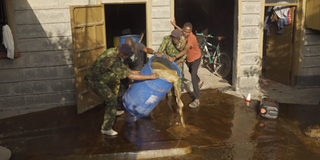
Police officers pour illicit brew confiscated from a homestead in Rhondaafter the raid on May 21, 2026
According to the county commander, officers recovered 32 jerry cans of 30 litres each containing pure ethanol, amounting to 960 litres.
He further states that police confiscated 36 jerry cans of distilled chang’aa, each carrying 30 litres, amounting to 1,080 litres.
“The operation also yielded 13 drums of 250 litres each containing molasses, alongside several jerry cans and distillation apparatus used in the illegal brewing business,” Boit says.
He opines that the illegal alcohol trade is fueling crime and substance abuse among young people within Nakuru County.
“When you see substances like these being distributed in our communities, you can understand why many young people end up engaging in crime,” he says.
Boit warns individuals engaging in the manufacture and distribution of illicit alcohol that security agencies will intensify operations across the county.
“Their days are numbered. They should stop these activities or face the full force of the law,” warns the county commander.

Nakuru County Commander Samuel Boit addresses the media after police confiscated more than 6,000 litres of illicit alcohol during a raid in Rhonda, Nakuru West
He says the four suspects remain in police custody and will be arraigned in court once investigations are complete.
“What I can say is that when you look at this area, you cannot easily suspect that such illegal activities are taking place within this compound. You can see the compound is well constructed and surrounded by a high perimeter wall, making it difficult to detect that illegal alcohol is being manufactured here.
We have recovered books containing records of individuals linked to this business. I have seen names and details captured in those books. Some of the records indicate people who were supplied with the illegal alcohol, while others show amounts of money involved in the sale of the alcohol.
There is also another book which appears to have been used to record returns and transactions.
He also warned police officers against colluding with illegal alcohol traders through bribery and protection rackets.
“This habit of taking ‘returns’ and having your names written in these books is wrong. Why should you be controlling crime while at the same time colluding with bad elements to destroy society?” posed Boit.
The county commander says authorities will scrutinize the records recovered during the operation to establish whether any officers benefited from the illicit trade.
“We are going to analyze the names captured in these books, and if we find that any officer has been listed, the necessary action will be taken against them,” he warns.