How a new agricultural extension policy could transform farming in Nakuru
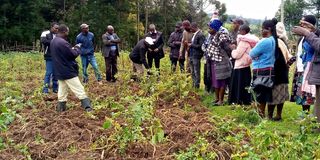
Kiptagich Ward Agricultural Officer doing extension to farmers.

Nakuru County is seeking to address weaknesses in agricultural advisory services through a proposed Agricultural Extension Policy, a framework that identifies staff shortages, fragmented service delivery and inadequate funding as some of the major obstacles limiting farmers' productivity.
The draft policy argues that while agriculture remains the backbone of Nakuru's economy, the systems meant to transfer knowledge and innovations to farmers have not kept pace with the sector's growing demands.
Agriculture supports more than 80 per cent of households in the county, yet many farmers still struggle to access timely technical advice, new technologies and reliable market information.

One of the biggest concerns highlighted in the policy is the shortage of extension officers. Nakuru currently has one extension officer serving about 1,143 farmers, almost twice the recommended ratio of one officer for every 600 farmers. The policy argues that this has reduced regular farm visits, delayed response to disease outbreaks and limited the county's ability to provide personalized support to farmers.
Beyond staffing, the policy points to aging infrastructure, inadequate transport, limited digital tools and weak coordination between public institutions, research organizations, private companies and development partners.
It also notes that although numerous organizations provide agricultural advisory services, many operate independently, leading to duplication in some areas while leaving other farmers without support.
Additionally, Climate change has also increased pressure on the extension system. Farmers are increasingly grappling with erratic rainfall, prolonged dry spells, floods, emerging pests and declining soil fertility.
However, the policy says extension services have struggled to consistently translate climate information into practical advice that farmers can apply at the local level.

Agriculture CECM Leonard Bor in a previous event.
Another challenge identified is the quality and consistency of agricultural information reaching farmers. The document warns that the absence of standardized qualifications for some extension providers and weak quality assurance mechanisms has allowed unverified messages to circulate, sometimes resulting in poor farming decisions and financial losses.
If adopted, the policy proposes recruiting more extension officers, investing in digital extension platforms, strengthening research partnerships, improving coordination among service providers and increasing funding specifically earmarked for extension services.
County Executive Committee Member for Agriculture Leonard Bor says the proposed policy is intended to provide a structured framework for improving how extension services are planned and delivered across the county.
"The policy provides a coherent and strategic framework to guide the planning, coordination and delivery of agricultural extension and advisory services while strengthening institutional capacity and improving access to quality services for farmers and other value chain actors," Bor states.
If approved, the policy would provide Nakuru with its first county-specific framework for coordinating agricultural extension services, with implementation expected to involve county departments, research institutions, farmer organizations, development partners and the private sector over the coming years.