Grooming future leaders: Nakuru launches first children's legislative forum

The clerks of the Nakuru County Children's Assembly during the inauguration of the Children's County Assembly on April 23.

Nakuru County has inaugurated its first Children's County Assembly, establishing a formal platform through which children can raise issues, petition the government, and participate in structured civic life.
The assembly, convened at the Kenya National Library Services Hall, marks a significant step in implementing Section 28 of the Children Act, which requires all counties to establish such bodies.
The Children's County Assembly is a representative forum for children aged 12 to 17, modelled along the lines of the county assembly.
Members are elected through a tiered process starting at the ward level, rising through sub-county assemblies, before culminating in the county-wide body.
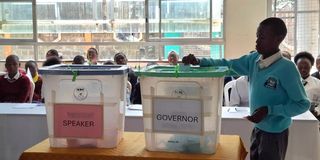
A student casts a vote during the inauguration of the Children's County Assembly on April 23
During the inaugural sitting, the 55 elected representatives - one from each of Nakuru's wards - were voting in their governor, deputy governor, speaker, and deputy speaker, with the Independent Electoral and Boundaries Commission (IEBC) officiating the elections.
According to Pilot Khaemba, the County Children's Coordinator for Nakuru, the assembly serves four core purposes.
“This assembly becomes a house of representation where children will be able to represent the sufferings and the issues affecting their fellow children in their respective sub-counties, the way members of county assemblies do,” he says.
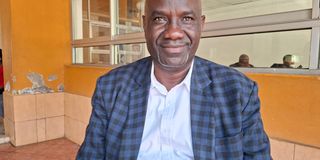
Pilot Khaemba, the County Children's Coordinator for Nakuru during the inauguration of the Children's County Assembly on April 23
He notes that the body will also function as a petitioning mechanism.
“Whenever they meet, after discussion, they will be able to write petitions and request their leadership to take those petitions to respective government offices for purposes of taking action,” he says, adding that government offices will periodically send responses back to the children's representatives on the progress made.
On advocacy, Khaemba notes that the assembly will serve as a vehicle for peer-to-peer empowerment.
“These particular representatives will be at the forefront to ensure that children take meaningful actions that contribute to their own lives and in their community,” he says.
The fourth purpose, he notes, is mentorship, where, from time to time, they shall be inviting government officers and professionals from different agencies who have succeeded in life to speak to the children.
Khaemba says the body is also intended to model a more constructive form of civic engagement for the next generation.
“There will be no reason in the future for people to demonstrate and burn buildings and create chaos, because these are the leaders who will be able in the future to conduct their affairs in a more orderly and organized way by way of petitioning,” he notes.
The elections on April 23 were preceded by civic education from the IEBC on gender and regional balance.
“If the speaker is a lady, why do we need a deputy speaker as a gentleman? Because it's the gender balance,” Khaemba explains, noting that children are being taught to value inclusivity alongside democratic competition.
He says the assembly's membership will be expanded in August, when the elected governor and speaker will nominate at least five children from special interest groups, which include children with disabilities and refugees, and will bring the total membership to approximately 60.
Members serve two-year terms, renewable once, and take an oath of office at the inaugural sitting.
Khaemba notes that the age bracket seeing that this is the age of criminal liability and that the law recognizes that they should know what is right and what is wrong.
On oversight, he notes that while the county secretariat facilitates and resources the assembly, governance is left to the children themselves.
“We are not involved in the day-to-day functioning,” he says. In cases of misconduct, he explains, a House committee would investigate and, if warranted, bring a motion to vote on removal. “Removing any one of them will be by way of voting,” he says.
The assembly will meet each school holiday, with the next sitting scheduled for August.