Green Belt Movement restores 69 acres of Dundori forest, hands back to KWS
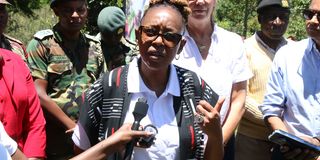
Chairperson of the Board of Directors of the Green Belt Movement (GBM), Nyaguthii Chege address media during a restoration drive of 68 hectares of degraded forestland in Dundori Forest, which also supports livelihoods and strengthen community stewardship. BONIFACE MWANGI

Formally Degraded stretches of Dundori Forest were handed back to the Kenya Forest Service (KFS) and the communities who live beside it on Wednesday.
The handover marked the restoration effort led by the Green Belt Movement (GBM) with funding from France through the Agence Française de Développement (AFD).
The handover is a milestone under Phase II of the Mau Reforestation Project, a move that has seen restoration of about 69 hectares of degraded Dundori forestland back under active rehabilitation and protection, with more than 75,900 indigenous seedlings planted and tended.

French Ambassador to Kenya Wadid Benaabou noted that the French – Kenya collaboration has always celebrated preservation of nature as a common priority.
“This is how we want to work with Kenya. A partnership of equals to protect the forests,” Wadid noted.
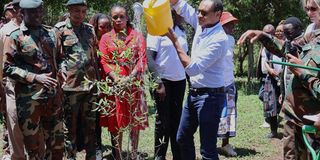
French Ambassador to Kenya Wadid Benaabou (right), Country Director French Development Agency (AFD), Anne-Gael Chapuis-Mirol and a member of the Green Belt Movement waters a tree he planted at Dundori forest on September 30, 2026
AFD's Country Director in Kenya, Anne – Gael Chapuis, said the agency has worked with GBM for more than 20 years and has financed two projects with the organization. More than € 2.6 million (Sh 381 million) has gone into this second phase.
"It's been very inspiring to be able to visit the nursery tree program to understand how it works and how we end up with this beautiful forest," Chapuis said.
GBM's Board Chair, Nyaguthii Chege, explained that communities adjoining the forest received financial and technical support, along with training, to raise seedlings. Some of those seedlings went into the forest. Others were fruit trees, which give households an income that outlasts the project.
"Communities who see a direct benefit from the protection of the forest are also the ones who will continue to protect the forest," Nyaguthii said.
According to Boniface Mulwa, head of Natural Forest management, Dundori is one of 14 KFS forest stations in Nakuru County and covers about 3,608 hectares, made up of natural forest and industrial plantations.
He noted that KFS estimated that about Sh 6.5 million has reached local people through casual labour, seedling production and supply, and related contracts. The work involved the local Community Forest Association and surrounding communities.
“The journey began in 2023. The station's Participatory Forest Management Plan had identified degraded areas in need of restoration, and with the help of GBM and AFD those areas were replanted with suitable indigenous species,” Mulwa noted.
GBM committed to work closely with the communities for three years after planting so that the trees reach maturity before being handed to KFS, which co-manages the forest with local people. The goal is a closed-canopy indigenous forest that protects water, air and climate.
Mulwa noted that the plan gives communities regulated access to the forest for beekeeping, water abstraction and grazing, making them partners and custodians of the resource.
"Partnerships are central to sustainable forest conservation and management, because we are in a position to leverage resources, technology and expertise,” Mulwa said.
He said Dundori fits into a wider push in Nakuru, which has been given a national tree-growing target of 29.8 million seedlings a year. KFS plans to raise 32 million seedlings every financial year to help the county meet it.
The project builds on a long history. GBM has spent more than 44 years, since its founding by Nobel Laureate Prof. Wangari Maathai, working to protect Kenya's water towers. It has built a network of more than 5,000 grassroots groups and planted over 55 million trees.