Egerton University students face uncertainity as lecturers’ strike drags on
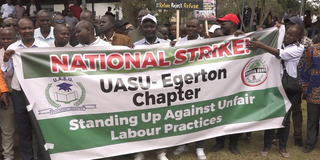
UASU Egerton Chapter members hold a "National Strike" banner at Egerton University as they launch a strike over the stalled 2025-2029 CBA on October 2

Students at Egerton University face continued academic uncertainty after negotiations between university workers and the government collapsed, with union officials saying they will maintain the strike until their demands are fully met.
The failed meeting leaves students unsure when learning will resume, with first-years worried about examinations and continuing students recalling how a previous strike disrupted their studies.
Dr Grace Kibue, Chapter Secretary of the Universities Academic Staff Union (UASU), says the meeting held last week ended without an agreement, with the parties asked to return to the drawing board.

“The meeting collapsed. So no deal was reached, and people were asked to go back to the drawing board. But for us, we are going to continue striking until our demands are met fully,” she says.
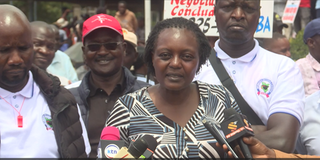
Dr Kibue says the union cannot give students formal instructions to leave university, arguing that decisions on whether institutions should close do not fall under its mandate.
“If students see there is no learning, they can go home or the universities can close. Our work is to ask our members to withdraw or withhold labor until such a time when our demands shall be met fully,” she says.
She adds that a resolution is unlikely in the near future, accusing the government of failing to demonstrate commitment to resolving the dispute.
“We cannot see it in the near future because the government seems to be dilly-dallying, and we are sensing a lot of non-commitment,” she says.
Students like first-year student Lynn Chakongo, says the continued disruption comes barely a month after joining the university, leaving her uncertain about how the interruption will affect her studies.
“These strikes will affect us because I am a first-year. We have just started our education, our first learning in university,” she says.

First-year student Lynn Chakongo speaks to journalists at Egerton University on October 2
Chakongo notes that students have barely settled into their academic programmes and are yet to fully understand their coursework.
“We have not been very engaged in our units and whatever, but now the strike is there. It is difficult for us to start because we do not know what the next thing will be,” she says.
She is particularly concerned about examinations and continuous assessment tests (CATs), which could follow immediately after the strike.
“We have not even started the CATs, but we hear that after the strike, immediately we will be doing our exams and CATs. So we do not know what the case will be and what we will write,” she adds.
Her concerns are echoed by Kevin Ngisa, a fourth-year Education Science student, who says a similar strike last year disrupted learning and affected students' academic performance.
Ngisa recalls that lecturers had to rush through the syllabus to recover lost academic time after teaching resumed.
“The education that we usually receive in our universities actually delayed, in a manner that even the way lectures were being taught, we were in a hurry,” he says.
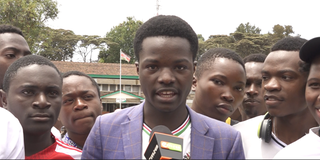
Fourth-year Education Science student Kevin Ngisa speaks to the media at Egerton University on October 2
He notes that the rushed teaching affected students' ability to grasp course content, with some struggling academically.
“Kindly, the government of Kenya, pay our lecturers so that they can be able to teach us in time, do our CATs in time and do our exams in time,” he says.
The union is also demanding the negotiation and implementation of the 2025–2029 CBA, alongside full implementation of the previous agreement. Kibue says the government should honour provisions mutually agreed upon during earlier negotiations.
Another point of contention is the Generic Human Resource Instruments, which the union says contain matters that should be negotiated through CBAs.
Kibue says teaching will remain suspended until the union's demands are met, apologising to students for the disruption.
“There will be no teaching in universities until our demands are met. The shutdown is very unfortunate and regrettable to our future dons, our students, but once the demands are met, we shall pick up from where we have stopped,” she says.