EACC faces scrutiny to deliver more as Nakuru corruption cases mount
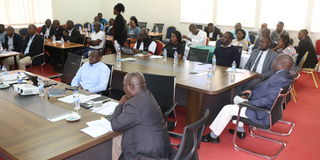
Members of the public listen as proceedings unfold during a public participation forum convened by the Ethics and Anti-Corruption Commission (EACC) on its 2027/2028 budget.

Twice in the past five weeks, Nakuru County officials have been marched into court over the use of public funds. First, a Sh120 million procurement and conflict-of-interest scheme in July, then a Sh50 million land deal for a health center just last month.
Against this backdrop, Miriam Njoki, a statistical officer with the Kenya National Bureau of Statistics, raises a version of that same concern at a public participation forum by the Ethics and Anti-Corruption Commission (EACC) on its 2027/2028 budget.centre
Njoki says the Commission should consider whether its increased budget is translating into more corruption cases being handled, while also investing more in public awareness and capacity building.

“We need to see more on training and capacity building because the public needs to be enlightened about what the EACC is doing,” she says.
She also questions the protection available to whistleblowers, saying fear of reprisals could discourage members of the public from reporting corruption.
“My question to the EACC is, do we have some sort of protection so that we can avoid these people fearing to come forward as whistleblowers?” she says.
Njoki says the increased allocation should enable the Commission to handle more corruption cases, resolve more cases and strengthen public education on corruption.

Miriam Njoki, a statistical officer with the Kenya National Bureau of Statistics during a public participation forum by the Ethics and Anti-Corruption Commission (EACC) on its 2027/2028 budget.
In FY 2027/2028, the Commission has been allocated Sh4.9 billion, up from Sh4.3 billion in the current financial year.
It says its proposed increase in funding will support a broader strategy that includes prevention, investigations, asset recovery and monitoring of major government projects.
David Ruto Too, the Commission's Director of Legal Services, says EACC is currently focusing on primary and service points, collaboration with regulatory agencies and professionals, and monitoring high capital-intensive projects to minimise losses.
He says the Commission is also giving greater attention to asset recovery, arguing that recovering stolen public resources can make corruption a high-risk undertaking.
“It is not only in areas of criminal prosecution, but also to create deterrence when funds that have been stolen or property is recovered from those who have engaged in corruption,” Too says.
He says the Commission is also conducting systems reviews in national and county government institutions to identify weaknesses that could create opportunities for corruption.
According to Too, the reviews enable the Commission to identify corruption risks and issue advisories to government institutions and devolved governments on addressing weaknesses in their policies and legal frameworks.
On answering about the closure given to the public about high-profile cases, the director clarifies that the public should not always interpret their searches and the subsequent questioning of officials as arrests.
Too says investigations proceed through several stages before the Commission makes recommendations to the Director of Public Prosecutions.
“When investigations have closed, we make recommendations to the Director of Public Prosecutions. And when he concurs with us that there is sufficient evidence to charge persons, that is when he gives directives for people to be arraigned in court,” he says.
He also says the Commission cannot disclose details of ongoing investigations, including specific cases that have attracted public attention.
Kipsang Sambai, EACC's regional manager for the South Rift region, while rejecting claims that the anti-corruption agency lacks the power to act against officials accused of corruption, says EACC is not a toothless dog. It has very sharp teeth and is biting.
He urges members of the public to provide information on corruption so that the Commission can pursue those involved while also helping to prevent people from engaging in corrupt practices.