Audit: Nakuru flagged for prioritizing bursaries over ECDE classroom development
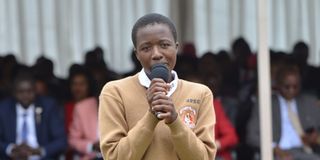
Caroline Atieno joined high school seven years after sitting for her KCPE.

Nakuru County could have built and equipped 339 pre-primary schools with classrooms, furniture and toilets had it channeled Sh1.018 billion allocated to bursaries towards Early Childhood Development and Education (ECDE), Auditor-General Nancy Gathungu has said.
A performance audit dated September 2026 has exposed gaps in the county's provision of early childhood education, including overcrowded classrooms, inadequate sanitation, shortages of teachers and incomplete infrastructure projects.
The report, tabled in the Senate on October 7, raises questions over the county's prioritization of bursaries at the expense of ECDE, a constitutionally assigned county responsibility.

Between the 2022/2023 and 2024/2025 financial years, Nakuru allocated Sh1.018 billion to secondary and tertiary bursaries, while ECDE received Sh1.673 billion.
The auditor noted that bursaries accounted for an increasing share of the education budget, rising from 18 per cent in 2022/2023 to 34 per cent in 2024/2025, while ECDE's share declined from 54 per cent to 45 percent.
Had the bursary allocations been directed to ECDE, the county could have provided 339 pre-primary schools with a classroom, furniture, four-door latrines and a urinal, at an estimated cost of Sh3 million per school.
The audit found that the county had not provided sufficient and appropriate infrastructure for pre-primary learners, with an estimated deficit of 763 classrooms.
Only 404 of the 1,062 ECDE centers met the recommended limit of 25 learners per classroom, leaving 658, or 62 per cent, exceeding the standard.
The congestion, the auditor said, restricted movement and learning activities, reduced interaction between teachers and pupils and hindered effective curriculum delivery.
The conditions of existing classrooms were equally concerning, with 735 of 1,875 classrooms, representing 39.2 per cent, being semi-permanent structures made of materials such as mud, iron sheets and wood.
Physical verification revealed leaking roofs, cracked walls and damaged floors, exposing learners to health and safety risks.
Sanitation was another major gap, with 573 centers lacking dedicated toilets for boys and 584 without separate facilities for girls.
Where dedicated latrines existed, the ratio was one toilet for every 41 boys and one for every 42 girls, against recommended ratios of one for every 30 boys, with a urinal, and one for every 10 girls.
The auditor also found that none of the 18 sampled schools had disability-friendly latrines, while five had toilet apertures wider than the recommended 20cm by 15cm, posing a risk of children falling in.
Inadequate furniture affected 424 centers, or 40 per cent, with some learners sharing worn-out desks and sitting on high benches without backrests.
Only 36 centers, representing 3.4 per cent, had fixed outdoor play equipment, limiting opportunities for children's psychomotor development.
The county's infrastructure delivery was also slow.
Of 481 planned pre-primary school infrastructure projects (Classroom Construction Projects, School Furniture Supply Projects, Fixed Outdoor Play Equipment Projects, Sanitation & Latrine Construction Projects), 323, or 67 per cent, remained incomplete at the time of audit fieldwork in July 2025.
The auditor attributed delays to budget cuts, reallocations to other vote heads, unrealistic project costing and delayed exchequer releases.
Development budget absorption stood at 22 per cent in 2022/2023, 32 per cent in 2023/2024 and 46 per cent in 2024/2025.
Teacher shortages compounded the problem, with 57 per cent of schools failing to meet the recommended teacher-to-learner ratio of one teacher for every 25 pupils.
Each pre-primary class had one teacher instead of the required two, a lead teacher and an assistant.
The county employed 847 teachers, while school Boards of Management hired another 1,383, accounting for 62 per cent of the workforce.
The reliance on locally employed teachers forced schools to charge parents fees to meet salaries, transferring the financial burden of a service meant to be free to households.
The audit further established that 181 of the 1,147 Board of Management teachers analyzed were not registered with the Teachers Service Commission.
The county did not recruit new ECDE teachers in the 2022/2023 and 2023/2024 financial years, citing lack of budgetary allocations.
Gathungu recommended that the county prioritize ECDE infrastructure, recruit adequate teachers, provide capitation grants for maintenance and learning materials, and allocate funds for teacher training and monitoring.
The Ministry of Education was also urged to strengthen quality assurance and coordination with county governments.