Abduction of Standard Group Associate editor Alex Kiprotich reignites concerns over journalists’ safety in Nakuru
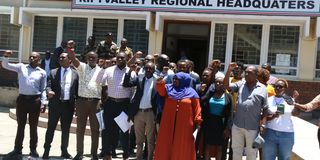
Nakuru journalists hold a peaceful protest following the abduction of Standard Group Associate Editor Alex Kiprotich.

The abduction of a senior journalist in Nakuru has renewed concerns over the safety of journalists in the county, with the incident coming barely two months after he was allegedly targeted in a similar incident.
Standard Group Associate Editor Alex Kiprotich was abducted on Tuesday night while travelling to Nakuru shortly before 9.20 pm by armed men along the Gilgil-Nakuru highway before he was found safe near Masinga Dam in the early hours of Wednesday.
But even as the Standard Group called for accountability, Nakuru County Police Commander Samwel Boit said the police had no knowledge of the incident.

Boit confirmed that neither the Standard Group nor Kiprotich had made a formal complaint to the police.
“We are not aware of the incident. We have not received any formal report,” he says.
The conflicting accounts raise further questions about how the incident will be investigated, particularly given claims by the Standard Group that Kiprotich had been targeted in June.
Mwita says the recurrence of the incident cannot be treated as a coincidence, noting that Mr Kiprotich has been at the forefront of the group's editorial output, including coverage scrutinizing the conduct of State institutions.
He says Tuesday's incident bore the hallmarks of a targeted attack on a journalist because of his work.
The claims, if established, would represent a serious threat to press freedom and raise questions about the safety of journalists whose work brings them into conflict with powerful institutions.
For journalists working in Nakuru, the latest incident is part of a much longer pattern with the county in recent years recording repeated cases of journalists being assaulted, shot, teargassed, threatened and harassed while carrying out their work.
Just last month, journalists from Nation Media Group covering the Ol Kalou Constituency by-election in Nyandarua County were assaulted, harassed and had their equipment confiscated by masked men and suspected security operatives.
In another incident, at least six journalists were assaulted and teargassed by police officers in 2025 while covering the chaotic arrest of Cleophas Malala, while they were covering events outside Kirobon Girls hosting the drama festival finalists.
The journalists, from Citizen TV, KTN and Inooro TV, were allegedly threatened and assaulted by police officers before using teargas to disperse them.
In July 2024, Kameme TV and radio correspondent Catherine Wanjeri Kariuki was shot three times in the thighs by police officers while covering anti-government protests in Nakuru, all while wearing a press identification jacket at the time.
The shooting triggered condemnation from media organizations and prompted journalists in Nakuru to protest against attacks on members of the press.
Yet the attacks did not stop.
In 2021, journalists covering political events in Nakuru were also attacked and harassed, adding to concerns about the treatment of members of the press while covering politically sensitive events.
The pattern has not been confined to Nakuru, and the response from media advocacy organizations has always been to issue statements condemning the attacks and call for investigations, accountability and protection of journalists.
The result has been a vicious cycle in which outrage peaks immediately after an incident, before attention shifts elsewhere and the case risks disappearing from public view.
The repeated incidents suggest that journalists are being reminded of the limits of their role through physical intimidation and threats while also raising questions about whether journalists can continue performing their role as the Fourth Estate when doing so repeatedly exposes them to retaliation