18 killed in 5 days: Motorists blame KeNHA, NTSA over Nairobi–Nakuru–Eldoret highway crashes
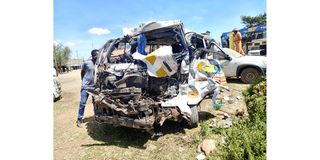
Wreckage of a Matatu involved in a 5am accident at Kikopey killing 7 people
Five days into the new year, Nakuru county is already counting bodies, with at least 18 people dying in a string of road crashes along the Nairobi-Nakuru-Eldoret highway since January 1.
This has turned the quiet optimism of a new beginning into yet another grim reckoning with the county’s most persistent killer, as too many lives, lost too quickly, on the same stretch of road that has for years been flagged as deadly but remains largely unchanged.
The first tragedy struck on New Year’s Day near Burnt Forest along the Nakuru–Eldoret Highway, where a container truck collided with a Toyota Voxy, killing two people and leaving another seriously injured.

Barely two days later, on January 3 at around 10 a.m., five people were killed at Kikopey on the Nairobi–Nakuru highway after a Bungoma-bound matatu was rammed from behind by a truck whose brakes reportedly failed.
The toll would rise to six as a patient succumbed to their injuries, while eight others were left nursing serious injuries from that crash.
Barely a day later, on the night of January 4, a head-on collision between a bus and a matatu at Karai in Naivasha claimed at least 10 lives, pushing the number of fatalities recorded in Nakuru County since the start of the year to at least 18.
The spate of deadly crashes has drawn sharp criticism from the Motorists Association of Kenya, which has blamed state agencies and long-standing institutional failures for what it describes as runaway road carnage along the Northern Corridor.
In a statement posted on their official Facebook page, the association has singled out sections passing through Nakuru County, including Kikopey, Mbaruk, Ngata, Delamere, and Mau Summit, as perennial black spots where deaths recur year after year.
The group questions why authorities continue to attribute most crashes to human error yet fail to explain why the same “errors” repeatedly occur in the same locations.
According to the association, the underlying problem is not recklessness alone but dangerous and outdated road design on a single-carriage highway that carries heavy commercial traffic.
It argues that congestion, lack of service lanes, poor signage, and the absence of designated rest areas for long-distance drivers create conditions where risky overtaking and driver fatigue become inevitable.
The association also accuses the Kenya National Highways Authority (KeNHA) and the State Department for Roads of failing to deliver long-promised expansion and redesign of the Nakuru section of the corridor, despite evidence that similar engineering interventions elsewhere, such as at Salgaa, have significantly reduced fatalities.
The association also faults the National Transport and Safety Authority (NTSA) over weak driver training and licensing systems, the police for what it terms rent-seeking enforcement practices that ignore known black spots, and county governments for failing to provide basic safety infrastructure such as lighting, pedestrian crossings, and truck lay-bys.
“The solution to road carnage is good governance and scientific intervention, not knee-jerk crackdowns after mass fatalities… Until institutions accept responsibility, Kenyans will continue to bury loved ones on a highway that should unite the region, not kill its people,” the statement reads in part.