Kihika VS Karanja: as leaders clashed the hard questions on emergency response remain unanswered

Governor Susan Kihika and Senator Tabitha Karanja during the funeral service held in honour of the 16 students at Gilgil Stadium on June 12,2026.

Few things expose the fragility of leadership more than the inability to accept criticism in moments that demand humility.
There is no worse time for leaders to engage in public score-settling than in front of parents still carrying the unbearable weight of burying their children.
Yet, even as grief hung heavily during the requiem mass ceremony for the 16 Utumishi Girls Academy students who perished in the dormitory fire, at the Gilgil stadium, Governor Susan Kihika and Senator Tabitha Karanja found themselves trading remarks rather than confronting the uncomfortable question that lingers: could the county have been better prepared?
While the senator stood to speak first, she categorically noted that perhaps the severity of the incident would have been avoided all together if there was a nearby fire truck in Gilgil sub-county.
“As one of our speakers has said, we should learn from this tragedy. If we had our own fire extinguisher here in Gilgil, I am sure we could have saved some lives. So our excellency governor, ensure that we have, in every sub-county, fire engines to ensure that we can respond to the disaster of fire as quickly as possible,” said the senator.
The governor, appearing to take issue with the senator's remarks, responded by emphasizing that the first fire engine to reach the school had been dispatched by the Nakuru County Government.
“I would be remiss if I did not respond to the senator and let her know, in case she was not aware, that the first fire engine at the scene and the fire engine that put out the fire and stopped it from spreading further was from the Nakuru County government.
The anti-stock-theft department got there first, and they immediately called us to have a fire engine at the school. So, I would hope you get your facts right before alluding to such inaccuracies,” responded the governor.
You see, the fact that the ‘first fire truck’ as per the governor’s words and logic came from Nakuru, neither negates the fact that 16 students still died in the fire nor, more importantly, invalidates the senator’s call for the establishment of fire stations in every sub-county.
This was never a contest over who reached the scene first, rather a moment that demanded introspection, accountability and an honest assessment of whether the county’s disaster response capacity is where it ought to be.
Currently, Nakuru County operates 3 main fire stations equipped with firefighting engines, with the primary stations being located in Nakuru Town, Naivasha, and Molo.
With eight other sub-counties relying on this limited network, the senator’s call for the establishment of fire stations in every sub-county cannot be dismissed as unreasonable.
Granted, expanding fire and rescue services across all 11 sub-counties would require significant investment, and available records show that the county has spent approximately Sh 450 to Sh 478 million in infrastructure and fleet development for the three existing stations.
The ultramodern Nakuru Town facility alone cost between Sh 174 and Sh 200 million to establish, alongside an additional Sh 113 million spent on fleet modernization, including the acquisition of two state-of-the-art fire engines.
Replicating a similar model across the remaining sub-counties would require substantial public investment, yet the county appears to be lagging behind its own timeline of establishing fire and rescue services.
In March 2024, the county government itself, through its website, announced plans to expand fire and rescue services to all sub-counties by 2027, a commitment made by then County Executive Committee Member for Public Service, Devolution, Citizen Engagement, Disaster Management and Humanitarian Assistance Jacqueline Osoro.
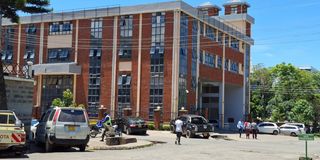
The ultramodern Nakuru Fire Station opposite Nyayo Garden.
In its own CIDP, the county acknowledges the need for a stronger disaster response system, setting aside roughly Sh 723 million over the five-year period for fire prevention, response and disaster mitigation.
Among the key investments is Sh 300.8 million earmarked for the construction and equipping of disaster management centers, with the county targeting the establishment of one center every year.
The plan also allocates Sh 560 million for the acquisition of four fire engines, Sh 170.7 million for assorted fire and rescue equipment, and additional funding for recruitment of firefighters, fire engine drivers, emergency response vehicles and disaster preparedness training.
The county further committed to strengthening fire safety compliance by allocating funds to increase inspections and the number of certificates issued from 115 to 400 annually.
Yet, with only 14 months remaining before voters return to the ballot, the question now is whether the current administration will fulfill the promise it made in the County Integrated Development Plan (2023–2027), or whether the responsibility will be passed on to the next leadership.
Or should must it take a tragedy of this magnitude for action to be taken?