No trophies, no titles: What Nakuru rugby teams learned in a season without silverware
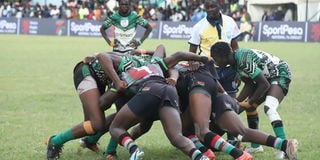
Nakuru RFC in a scrum with Kenya Harlequins during Prinsloo 7s held at the Nakuru Athletics Club on August 2,2025.

As 2025 draws to a close, Nakuru’s rugby scene reflects a year that has been defined less by trophies and more by consistent development, resilience, and renewed optimism.
Through the efforts of Menengai Oilers and Nakuru RFC, the county has continued to establish itself as a key source of rugby talent, nurturing players who are increasingly confident on the national and regional stages.
At Menengai Oilers, head coach Gibson 'Gibu' Weru presided over a season defined by development, culture, and competitive consistency. Although the club narrowly missed out on major honours, Weru believes that success should be measured beyond results.



Menengai Oilers head coach Gibson Weru, wearing a blue jersey, after their match against the Daystar Falcons on November 22, 2025 at the Refinery Grounds in Nakuru, which they won.
“From a club perspective, one of the key areas we focus on is player welfare and culture, ensuring that we are nurturing good men and responsible citizens. That’s a big success for us,” he says.
On the field, the Oilers made an encouraging start to the year by winning the Floodlit Tournament, a key 15s title in the early season, which they also won in the pre-season. However, the campaign was marred by agonisingly close defeats in the Kenya Cup and Enterprise Cup finals.
A third-place finish in the Kenya Cup standings confirmed their status among the elite, but the missed opportunities provided valuable lessons.
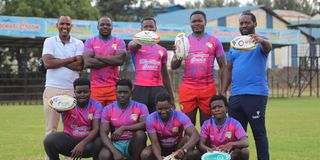
From left Back row, Menengai oilers head coach Gibson Weru and Teddy Omondi, Rugby Regional Development Officer in Paris in the company of Menengai Oilers players as they received ball donations.
“In finals, everything comes down to preparation and experience. We learn from losses and make sure our players are ready next time,” notes Weru.
In the shorter Sevens format, the Oilers prioritised giving young players exposure over immediate results. The team reached two finals and finished third overall, which was an improvement on the fourth-place finish of the previous season. Weru says this approach has widened the club’s talent pool and prepared players for greater demands.
This development pathway was evident in the selection of the national team. Six Oilers players earned call-ups to the Kenya Under-20s squad touring Zimbabwe — the first time this has happened in the club’s history — while 13 players featured for the Kenya Simbas. Daniel Kipchirchir also joined the Shujaa Sevens squad, further extending the club’s national presence.
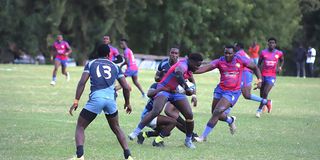
Menengai Oilers player Celestine Mboi makes a ball carry in their Kenya Cup match day 1 against Daystar Falcons held at Refinery grounds in Nakuru on November 22, 2025.
“Seeing our players represent Kenya confirms that we’re doing things right and inspires others within the squad,” says Weru.
Standout performers included academy graduate Brian Achacha and Clarkson Keegan, who successfully transitioned positions, as well as Samuel Mwaura. Samuel Ovuam was named Player of the Season for his consistent top-level performances.
Looking ahead to 2026, the Oilers are focused on tightening their defence, sharpening their attack, and approaching every fixture with final-like intensity, while continuing to invest in youth.
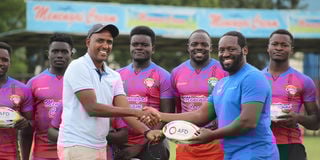
Menengai oilers head coach Gibson Weru and Teddy Omondi, Rugby Regional Development Officer in Paris in the company of Menengai Oilers players as they received ball donations.
“Meeting teams like KCB and Kabras will always be tough, but we’re well prepared. We’re optimistic as the season resumes in January,” says Weru.
While the Oilers operated on fine margins at the top end of the table, the Nakuru RFC experienced a season driven by youthful energy and gradual progression. According to club official Edward Moseti, a largely inexperienced squad showed clear improvement over the course of the year.
“We had a very young squad, and they were very explosive. We retained more than 90 per cent of the players, so next season should see an even better team,” he says.
Under the guidance of local coaches Oscar Ouma and Donald Aluoch, Nakuru RFC also delivered some promising Sevens rugby performances. Felix Okoth and Javan Otieno emerged as standout players, earning call-ups to the national team, while academy talent Josphat Njunye contributed crucial points and depth.
Veteran players also played an important off-the-pitch role, contributing to coaching and mentorship, as well as efforts to secure vital sponsorship support.
Despite facing challenges in the forward pack and losing key players such as Philip Okeyo to Menengai Oilers, Nakuru RFC finished the first half of the season in eighth place, which is a significant improvement on the previous year.
"The players have grown mentally. Each game showed progress. The next round will be challenging, but the team is ready,” says Moseti.
Both clubs have also made valuable contributions to Kenyan rugby at a national level: the Oilers have supplied 18 players to the Simbas, Shujaa and Under-20 teams, while Nakuru RFC has contributed three players to national squads.
While titles remain the ultimate goal, 2025 demonstrated that the real strength of Nakuru rugby lies in player development, resilience, and a growing culture of excellence. If this year is anything to go by, 2026 promises to be an even brighter chapter for the county’s rugby ambitions.