21-year-old Egerton University student taking lead in sensitizing girls on digital security
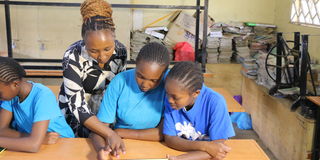
21-year-old Linet Kamotho, founder of Space Shift Initiative, works with her grades 8 & 9 'Girls in Robotics' students at Kilimo Junior School in Njoro- Nakuru.

When Linet Kamotho walked into the first cohort of the African Girls Can Code Initiative by UN Women in 2023, she felt out of place. Then, surrounded by girls who seemed to speak the language of technology fluently, the then-19-year-old born in Nyandarua County felt intimidated because she could not understand a thing.
She, however, made friends who held her hand and let them teach her the ins and outs of coding.
Now 21, Kamotho is a third-year Biochemistry student at Egerton University and Founder of the Spaceshift Initiative, a youth-led organization focused on raising awareness on cybersecurity, cyberbullying, and digital skills.

After the African Girls Can Code program, she went on to the Siemens Empower Hub, where she was introduced to cybersecurity.
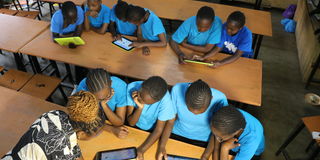
Grades 8 & 9 'Girls in Robotics' students at Kilimo Junior School in Njoro- Nakuru squeeze in a robotics session where they engage in tablet-based learning as part of Space Shift Initiative's STEM program
Shocked by how vast the field is and the different threats many face online, she says she got interested in cybersecurity and specifically threat intelligence analysis because she wanted to give back and raise awareness of the digital threats facing her community.
“Later, when the opportunity to lead the Girls in Robotics Kenyan Chapter came after several mentorship sessions on leadership, I took it without hesitation despite not knowing where to start. I figured the numerous lessons I had gone through would come in handy,” she says.
Kamotho sought certification from the education offices in Nakuru and noticing that Kilimo Comprehensive School was close to her, decided to seize the opportunity.
“I now teach the girls here tech and robotics, and this is sort of my second cohort of Grade 8 and 9 students,” says the Country Director of the Girls in Robotics Kenyan Chapter, adding that she teaches on Fridays during the students' lunch break, and that brings her immense happiness and motivates her to get motivated by her own students.
She notes that the girls not only learn technical skills but also soft skills through mentorship, where they have learnt to navigate the internet safely and build their financial literacy.
The students have also engaged in peer-to-peer learning with counterparts in South Africa, participated in several hackathons, and completed three projects on the Internet of Things (IoT) under the ‘My Planet, My Home’ initiative, where students use technology to identify and respond to climate change challenges in their communities.
Kamotho focuses on girls and notes that notes that despite the existence of equality, there comes a point where girls need a bit more uplifting than their counterparts more so in a field as male dominated as technology.
“My dream is to see more girls surfing the internet, learning how to code, building solutions around them,” she says.
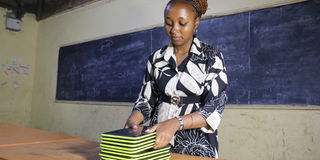
Linet Kamotho sets up for another session of the Girls in Robotics program for grades 8 & 9 students at Kilimo Junior School in Njoro- Nakuru.
Whereas there are many organizations that teach cybersecurity, Kamotho notes that not many of them reach the grassroots level. She also recognizes that cybersecurity can feel like a monster to ordinary people.
Therefore, through the Space shift Initiative, she is trying to change that, and the organization has launched a solution called Cyber Bila Stress - a podcast that uses storytelling in Swahili to educate communities on how to stay safe in the digital world.
“We've recorded a podcast bringing in lived experiences, using storytelling in Swahili to educate communities on how to stay safe digitally,” she says, adding that they look forward to translating the content into as many vernacular languages as possible.
Spaceshift was also among the top innovators at the AU Go Girl initiative, where the team is building an animated video game designed especially for young people.
As the project develops, she says they plan to incorporate additional languages so that anyone and everyone can learn how to stay safe online. She adds that she would welcome more support from the government and other organizations to reach more young girls and boys across the country.
Despite her growing profile in the tech world, Kamotho does not see technology as a side quest to her academic path, and as a Biochemistry student, she says she is actively looking to venture into medical research and envisions technology as central to that journey.
“I want to be a Bioinformatician - to identify the sequence of genes and all that - but using tech and creating more informed decisions for medics and researchers out here,” she says.