One man’s rhythm: How Benito’s Salsa Journey shaped Nakuru’s dance culture

Ben Karanja commonly known as Benito Salsa guiding a Salsa enthusiast at the Salsa Party on 14 September 2025

Ben Karanja, commonly known as Benito, is quietly reshaping Nakuru’s social scene by introducing and growing salsa dancing in a town where the style was once almost unknown.
His dance journey began in 2010 while he was living in Eldoret. At the time, Benito and his friends were mainly involved in modern dance. During one of their performances, they entertained visiting guests who were impressed enough to reward them, and in the process, introduced them to salsa.
“That performance changed everything for me. That’s how my salsa journey started,” he says.

Alongside dancing, Benito was pursuing a Diploma in Business Administration in college. Although dance was not widely supported by parents in the past, his persistence slowly changed perceptions at home.
“At first it was not something parents supported, but my mum started supporting me after she saw me on TV several times,” he explains.
What pulled him deeper into salsa was its elegance. “Salsa seemed classy and elegant, and that really drew me to it,” he says.
This passion saw him perform at Mount Kenya University, after which he returned to Nakuru with a clear intention of starting a dance community.
While in Nakuru, Benito met a fellow salsa dancer, and together they began practicing to perform. They soon showcased their work at Nakuru Players Theatre and other platforms. Because salsa was still new in the town, people's interest grew quickly.
However, growing the scene came with challenges. Although audiences enjoyed the performances, enrolling students for classes proved difficult.
“This was a very new dance in Nakuru, and I hadn’t really understood my target audience,” Benito says. Securing practice venues, maintaining consistency, and booking paid shows were also major hurdles. “Even booking shows was not easy. We got a lot of ‘tuta kupea platform’ kind of offers,” he adds.
A turning point came when Benito identified universities as an opportunity. He discovered that Egerton University already had a salsa team and went on to introduce salsa at Rift Valley Institute of Business.
“That’s when the numbers started growing. We had enough dancers to organize shows and even flash mobs,” he recalls.
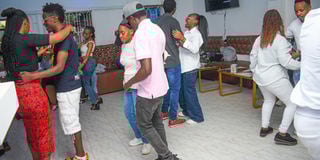
Salsa dancers on the dance floor at the Salsa Party on 14 September 2025
Between 2016 and 2019, Benito worked with instructors from Nakuru and Egerton to organize flash mobs that helped popularize salsa across the town.
Today, the Nakuru salsa scene has expanded significantly. Benito has hosted salsa nights as well as numerous local events. He regularly books venues and DJs and invites instructors from Nairobi and beyond to conduct master classes. “We bring in instructors to improve our skills and spice up the dance,” he explains.
Currently, through a partnership with the Egerton University salsa team under the leadership of Mariam, Benito is preparing to host a national salsa event in February. In addition, salsa shows are held at Nakuru hotels.
He currently offers salsa classes at Family Care (FHOK) at a fee of Sh 5,000 per month. Beyond teaching dance, Benito has a broader vision for the future.
“I want to have shown where we celebrate different cultures, their diversity, and learn why people do certain things,” he explains. “We express that through dance, songs, outfits, and language.”
Benito also points out common misconceptions about salsa. “Many beginners don’t want to invest, commit time, or pay attention because they believe it’s easy,” he says.
He is also keen to dispel the myth that salsa is only for couples. “Salsa is structured but also free. You first understand the foundations, then you express yourself depending on the music, musicality, and emotions.”
Asked about his favourite salsa song, Benito smiles and says, “Aisha by Africando.”
Through consistency, creativity, and determination, Benito has steadily built a vibrant salsa scene in Nakuru, laying a strong foundation for a dance culture that continues to bring people together, expand artistic expression, and redefine the town’s nightlife and social spaces.