Uproar over felling of Jacaranda trees along Oginga Odinga road as expansion work begins
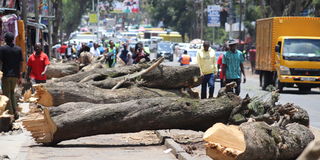
Felled Jacaranda trees along Oginga Odinga street on 23 September, the trees were cut to pave way for dauling of Oginga Odinga street.

Nakuru wears its nostalgia the way South Korea wears its cherry blossoms, except here, it isn't pink, it's purple. For decades, the Jacaranda has been less a tree than a season, a mood, a memory.
Every October, the canopies over Milimani's neat tarmac roads turn violet, and for a few weeks the town becomes a photographer's dream: brides, graduates and casual strollers alike pausing beneath the blossoms for a picture that says, unmistakably, "this is Nakuru."
The debt for that beauty is owed to a man most residents have never met. Frank Walter Jameson, better remembered by his nickname, Jacaranda Jim, was the engineer who, in the early twentieth century, seeded the streets of Nairobi, Nakuru and other towns with the purple-flowering trees he had already made famous elsewhere in the region.

The colonial administrators who commissioned him wanted ornament, something to soften the newness of the towns they were building and perhaps to remind them faintly of home. Jameson died in 1956, but what he planted outlived the empire that ordered it, rooting itself so deeply into Nakuru's identity that the trees now feel indigenous, even though they aren't.
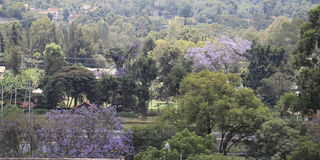
Blossomed Jacaranda trees in Nakuru,most of these trees were planted during the pre-colonial period
Oginga Odinga Street is one of the streets that best carries that inheritance, rows of jacarandas meeting overhead to form a living arch that has sheltered generations of pedestrians, cyclists and marketgoers.
That arch is now being cut down. As part of a five-kilometre dualling of Oginga Odinga road, mature Jacarandas are being felled to make way for road expansion, and for many residents, this is where nostalgia collides with accountability.
It would not be the first time the town's canopy has been sacrificed to a highway. Older residents still recall an earlier round of tree clearing tied to the dualling of the Nairobi–Nakuru road through Lanet, a loss some in the city have never quite forgiven the authorities for. Over 200 jacaranda trees are said to have been cut during that road construction around 2007.
What makes this round harder to accept, according to environmental activist James Wakibia who has been following the project closely, is not really the trees' species or their sentimental value, it’s the logic behind the felling itself.
He clarifies his support for the road expansion but argues that the section being cleared has walkways where precisely where shade matters most.
A road, he points out, doesn't have to be tarmac from edge to edge, one side for pedestrians, a bicycle lane, a green median, then the motor-able middle.
“Planting a Jacaranda seedling today will have considerable effect in forty or fifty years, the canopy that took a lifetime to grow cannot be replaced by a replanting pledge. My position, then, is not anti-development, it's that mature trees should be designed around development, not bulldozed first and apologized for later by replanting efforts,” he lamented
His sharper complaint is procedural: no environmental impact assessment, no genuine public participation, the project feels rushed through to benefit a handful of politically connected developers rather than the ordinary Nakuru residents, traders, students, commuters, who actually use the avenue.
“I have watched trees felled and loaded onto trucks, by a sitting member of parliament, and wants to know where that timber is going and under what authority,” he questions.
His message to the county government, the Department of Environment and the road agency is simple: infrastructure is supposed to serve the public, not bypass it. Nakuru can have its dual carriageway. What it cannot easily get back, once the chainsaws finish, is the environmental impact, shade and beauty its people grew up under.