Parenting an autistic child: Father's journey of strength and resilience
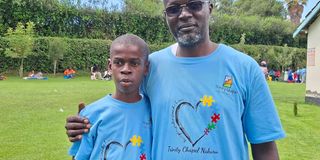
Patrick Menya Obunga together with his son Emmanel Shujaa Menya during the commemoration of the 2026 World Autism Awareness Day, at Trinity Chapel Nakuru on April 4

There is a particular kind of exhaustion that comes with caring for a child the world does not fully understand. That care often goes beyond the physicality of it and morphs into spaces where caregivers have little to no control, and for many parents raising children on the autism spectrum, it eventually becomes depression.
Patrick Menya Obunga knows this weight. His son Emmanuel Shujaa Menya, 13, was diagnosed with autism after a period of delayed milestones compared to peers his age (walk and speech) and eventually seizures that made it clear something more serious was at play.
In the years that followed, Menya not only learned to care for his son, but he also learned to work around the stigma that came with it.

“Often the stigma that goes on is people saying parents have sacrificed their children to make money or that our children are mad,” he says, adding that these stereotyping tendencies often don’t sit well with many parents and could contribute to frustration but a first step as a parent is acceptance.
It is this reality, playing out silently in homes across the country, that drew dozens of families to Trinity Chapel Nakuru on April 4, as the church marked World Autism Awareness Day 2026 for the fourth consecutive year.
Very early on, Menya found ways to cope, among which was enrolling his son in an integrated school, a decision he says has made a visible difference, and to decompress from the pressure, he says the outlets are sometimes as simple as shouting, dancing, or singing.
“Find something that gets you off the pressure- find someone you can talk to,” he says, adding that as a Christian, prayer has also been a constant anchor. But perhaps the most grounding decision was finding a community that did not require him to explain himself. “I found it very interesting that the church actually has a section for autistic children and they welcome them.”
Autism is a lifelong neurodevelopmental condition affecting social interaction, communication, and behavior, according to the WHO, noting that it is among the top 10 brain health conditions contributing to health loss globally.
Despite international human rights conventions, autistic people still face stigma, discrimination, and barriers to participation. Additionally, access to timely, quality health care and support services remains limited, driving inequalities across the life course.
Addressing these challenges requires sustained action and greater investment in inclusive policies and services that uphold the rights of autistic people.