Moi, Komen out to reclaim Rongai MP seat from Chebor
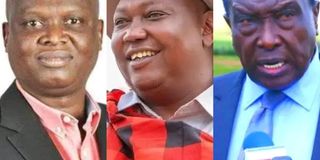
From Left: Kibet komen, Paul Chebor and Raymond moi

Rongai MP Paul Mamba Chebor may have won the seat in 2022 riding on the UDA wave that swept across the Rift Valley, but as the 2027 political season slowly begins taking shape, the first-term legislator now appears headed for what could become another toughest battle of his political life - facing off once again against powerful political dynasties that have long shaped Rongai politics.
Unlike many of his competitors, Chebor’s rise to power was not built on a famous political surname, inherited influence, or deep-rooted family networks.
He has previously been described as a humble man who once worked as a herder before gradually building his profile within grassroots politics and community mobilization in Rongai Constituency.

His victory in 2022 was therefore viewed by many as an upset against established political heavyweights who had for years dominated the constituency either directly or through family influence.
For decades, Rongai politics has largely revolved around two influential families: the Komens and the Mois.
The Komen political influence in Rongai stretches back to former MP William Komen, one of the earliest leaders to hold the seat after the constituency was created. Over the years, members of the broader Komen family have remained politically visible within Rongai and Nakuru politics, with different family members either contesting seats or serving in influential government positions.
Among them is Raymond Komen, who served in the previous Nakuru County administration as the County Executive Committee Member for Trade before unsuccessfully contesting for the Rongai parliamentary seat in 2022, where he lost to Chebor.
Now, Kibet Komen, who is also another member of the family, has been garnering favor from the constituents and is preparing to carry the Komen political mantle into the 2027 contest, potentially setting the stage for yet another attempt by the family to reclaim influence over the constituency.
This he confirmed to Mtaa Wangu in a phone interview, clearly stating that his brother Raymond would not be in the race this time round.
But perhaps the most visible political dynasty in Rongai remains the Moi family.
It is known that the Moi name carries enormous political weight in Kenya owing to the legacy of former President Daniel arap Moi, who ruled the country for 24 years and built one of the most influential political networks in the Rift Valley and beyond.
Even years after his retirement and death, members of the family continue to wield some sort of political and economic influence across several sectors.
In Rongai, that influence was cemented through Raymond Moi, son of the late president, who held the parliamentary seat for two consecutive terms between 2013 and 2022 under the KANU party ticket.
For years, Raymond Moi was viewed as the face of Rongai politics, benefiting from both the Moi family name and the enduring KANU networks that still command loyalty in sections of the constituency.
However, the 2022 election saw Chebor unseat him in what many observers may have interpreted as a symbolic rejection of dynasty politics amid the broader political realignments that accompanied the rise of UDA in the Rift Valley.
Yet the Moi political machine may not be done with Rongai just yet.
In recent months, Faith Milka Moi, linked to the wider Moi family, had surfaced online with indications of political interest in the Rongai seat, sparking speculation over a possible bid ahead of 2027.
However, her political activities have since gone relatively quiet, with little visible grassroots mobilization or public campaign structures emerging so far.
Still, with the Moi name remaining politically influential and the Komen family seemingly reorganizing, Chebor now faces the possibility of defending his seat against renewed pressure from families that have historically shaped Rongai’s political direction.
The looming question within Rongai politics is whether Chebor’s 2022 victory marked the beginning of a new grassroots’ political era — or whether it was merely a temporary interruption in a constituency long dominated by established political dynasties.