From calls to action: How Nakuru creatives led the push for civic change in 2025
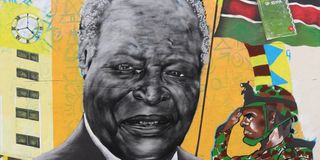
Artwork done by Dante arts, a Nakuru based creative artist, during the celebration of Katiba at 15 this was complemented by a Katiba at 15 events organised by Tribeless Youth Kenya.

For years, creatives in Nakuru separately delivered their civic messages and opinions through their talents which called for actions from their specific audience.
In 2025 however, the group seemed to take a different approach where they embarked on a well-coordinated activities that signaled a pro-active role in re-shaping how democracy is discussed, learned and lived, using art as both a mirror and a megaphone for civic action.
At the heart of this shift are platforms such as Baraza Media Lab and Tribbles Youth Kenya, which have deliberately placed art at the center of civic education.

Through poetry, music, theatre, photography and street performances, Nakuru’s creatives are ensuring that residents are not left behind in conversations on governance, accountability and participation.
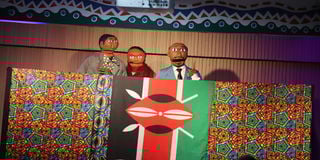
Smart Perpetters display a show for an audience at the Baraza Media Lab, urging Kenyans to register as voters ahead of the 2027 General Election
Speaking to Mtaa Wangu, Samuel Njoroge, popularly known as Priest the Poet, says Nakuru creatives have historically played a passive role when it comes to civic matters which they sought to change through their programs
“Nakuru has had few artists being vocal when it comes to civic education. But recently, there has been a breed of artists who have been well-incubated into civic education, and through their art, the community is now learning,” he says.
Njoroge serves as the Community and Operations Associate at Baraza Media Lab, a creative hub that has played a key role in nurturing this transformation. One of its flagship initiatives, Civic Canvas, emerged from reflection following the nationwide protests of June 25, 2024.
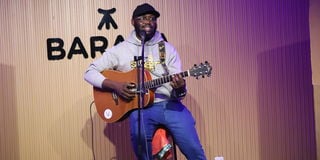
Samuel Njoroge, popularly known as Priest the Poet, the Community and Operations Associate at Baraza Media Lab, performs his song Twende Kwa Ballot, urging Kenyans to register as voters ahead of the 2027 General Election
Baraza Media lab realised that while many artists were already producing powerful civic-themed work, they lacked a platform to present it.
“We had photographers with very intriguing images, videographers, poets, singers, actors with strong stage plays, but they didn’t have a place to stage this art. Civic Canvas came in as a platform where artists could showcase work that speaks directly to civic education to Nakuru residents and the audience grew with each show,” Njoroge explains.
Njoroge says the initiative found fertile ground within the After Five Street Vibe, an event that happened every Friday in the city centre and attracted diverse audiences.
“By merging entertainment with sensitization, Civic Canvas turned public spaces into learning spaces. The impact was immediate and tangible. Beyond packed audiences and extended performances, the initiative sparked civic action,” he notes
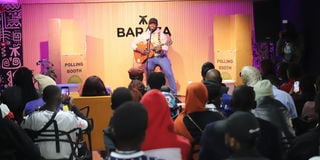
Samuel Njoroge, popularly known as Priest the Poet, the Community and Operations Associate at Baraza Media Lab, performs his song Twende Kwa Ballot, urging Kenyans to register as voters ahead of the 2027 General Election
Beyond this, the organisers and creatives engaged the Independent Electoral and Boundaries Commission (IEBC) in Nakuru, pushing for youth voter registration.
“The same masses that come out to protest are the same masses that should be lining up during elections. If we rant before and after but don’t vote, then we are failing ourselves,” Njoroge says, explaining how their partnership with IEBC encourages young people to register as voters.
He describes the initiative as a major success, not just for Baraza Media Lab or After Five Street Vibe, but for the wider community, which continues to demand similar engagements as the country edges closer to the 2027 General Election.
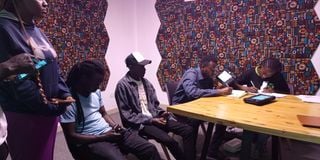
IEBC Assistant Registration Officer for Nakuru Town East, Stephanie Pelloh registers voters at the Baraza Media Lab on November 26, 2026
That momentum has been reinforced by youth-led movements such as Tribbles Youth Kenya, which has consistently championed good governance, accountability and inclusion.
According to Shikoh Kihika, co-founder of Tribbles Youth Kenya, 2025 has been a defining year for art-driven civic education.
“It’s been quite a success. We have seen a lot of changes, and I can confidently say we’ve been pioneers of doing events differently as Tribeless Youth,” Kihika says.
She notes that one of the biggest wins has been seeing other organisations and institutions adopt similar creative approaches of using art for civic engagement.
“When you see others acknowledging that art can educate and bring people together for civic change, that tells us we’re on the right path,” she says.

A youthful audience at the Baraza Media Lab for an event which combined music , play and voter registration
However, Kihika is clear that success is not just about numbers or visibility. For Tribbles Youth Kenya, the deeper goal is mindset change, something she says is still ongoing.
“We are still journeying. But we are seeing creatives shifting their art. not necessarily activism-centered, but more change-oriented,” she explains.
Among the standout initiatives of 2025 was Tribbles Youth Kenya’s Uwazi Festival, which brought together artists and young people from across Nakuru County and beyond. For the first time, participants came from neighboring counties such as Kericho and Laikipia, signaling a growing regional footprint.
Another event that brought Nakuru people together was the Chukua Kura festival, held in partnership with the IEBC and Midriff Hurinet. The festival combined art, dialogue and voter registration, allowing young people not only to register as voters but also to understand why the process matters.

IEBC Assistant Registration Officer for Nakuru Town East, Stephanie Pelloh registers voters at the Baraza Media Lab on November 26, 2026
“Beyond voter registration, creatives tackled harder governance issues in Nakuru County, such as transparency, accountability and the misuse of devolved resources. Artists addressed police brutality and as well as inclusivity,” Shikoh states
Kihika believes art offers a more effective and relatable way of communicating these complex issues.
“Young people are tired of lectures. They want to write their own story, and that story can best be written through art,” she says.
Looking ahead to 2026, both Baraza Media Lab and Tribbles Youth Kenya plan to expand their reach. The focus will be on taking civic conversations into informal and unconventional spaces as political activity intensifies ahead of the 2027 elections.
“We’re going to take art to the next level. Bigger festivals, better platforms, and conversations in unusual spaces, because campaigns officially begin next year,” Kihika says, noting they want each Nakuru resident to be informed both of their rights and what is needed of them.
For Kihika, one of her proudest moments of 2025 has been stepping back and watching young people take ownership of civic spaces.
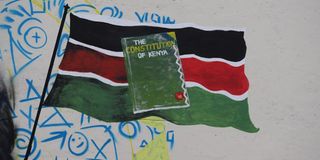
Artwork done by Dante arts, a Nakuru based creative artist, during the celebration of Katiba at 15 this was complemented by a Katiba at 15 events organised by Tribeless Youth Kenya.
“Seeing young people organise themselves, run platforms like Poets You Should Know, follow up court cases and stand in solidarity, that has meant everything to me,” she says.
Through sustained civic education rooted in art, inclusion and community ownership, Kihika and Njoroge believe Nakuru can continue building a more informed, engaged and fearless citizenry.