Families of 2024 Gen Z protest victims demand closure despite compensation promise
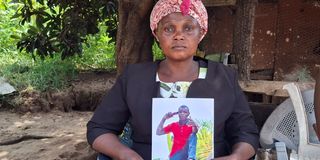
Violet Gwazina, 25-year-old Kelvin Madaga's mother.

Two years after the fatal shooting of Kelvin Madaga, pain remains deeply etched in his mother’s, Violet Gwazina, heart, and while time has moved on, she says her grief has not.
They are among families that are still coming to terms with the death of their loved ones following the 2024 anti-government protest on the Finance bill.
Seated outside her modest home in Ngata estate, Rongai sub-county, Gwazina notes that the loss has been both emotional and economic.
As she fights back tears, she recalls the life and dream of her lastborn child, who was shot and succumbed to injuries three days later while receiving treatment.
“While growing up, Kelvin had considered joining the military before eventually settling on pursuing teaching as a career. At the time of his death, he was a first-year student at Migori Teacher College,” she says.
She notes that at the time of the protest, Madaga had been sent home due to school fees when he decided to visit his friend in Pondamali estate within Nakuru Town West Sub-County, where he opted to join fellow youth in protest.
Despite his friend pleading with him not to join, he excused himself, promising to return, and even left his bicycle behind, and that was the last time he was seen alive.
“After he failed to return home, we tried reaching him on the phone, but the calls went unanswered, and later it was switched off. We didn’t know of his whereabouts for three days,” she recalls.
It was during a visit to the Nakuru Teaching and Referral hospital to check the patients who had been brought to the facility from the protest, when they opted to visit the mortuary to check if his brother was among the two young men who had been allegedly shot dead.
At the mortuary, his elder brother later learned that Madaga was brought to the facility by good Samaritans and was admitted to the Intensive Care Unit (ICU), where he succumbed to injuries.
“He had been shot three times. Two in the chest and one in the neck.
Every time I think about my son. I do not know if I will ever forget him. The pain is still fresh two years later. He was a good son who helped me in every way he could. He had secured a teaching job within the estate, and he was passionate about it. He could not wait to complete his studies and be a full-time teacher,” Gwazina says.
Remembered as a hardworking and caring son who was always ready to help, she said his absence is felt every day in the home he once helped maintain.
“He used to help me keep the compound clean. Whenever I see things that need to be fixed, I remember him and think that if he were here, things would be different. A mother would rather see her child walking and alive than remembering them in death. He might be gone, but I will carry his memory with me for the rest of my life. He loved me very much; he was my helper and my friend,” she says.
As the family marks the second anniversary, Gwazina maintains that no amount of compensation can replace the life of her son, saying the loss of a child cannot be measured in monetary value.
However, she describes justice as recognition of lives that were lost during the protest and those responsible for pulling the trigger to be held accountable.
“Even if someone gives me millions of shillings, I cannot go to the market and buy another child. Money cannot replace my son. I would like to stand with other mothers and remember our children. Last year we travelled to Nairobi, but this time there are no plans, I will just host church members and relatives for prayers, “she says.
As the families will be commemorating their two-year anniversary, Gwazina hopes to join others in Nakuru or Nairobi just to light candles and lay flowers in memory of those who died during the protest.
For the family of Austin Makhoha, her mother, Maria Khayange, says life has never been the same after her firstborn son, who was living with autism, was shot dead during the protest.
On the day he was shot, Khayange said that Austin had left their Kabachia home to pick up his younger siblings, who were playing outside, when he was caught up in the chaos as police officers engaged protestors who had tried to invade the Nakuru statehouse.
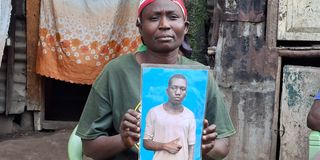
Maria Khayange, 17-year-old Austin Makhoha's mother.
According to Maria, he was not part of the protest and had simply gone to ensure his siblings were home safely when they heard gunshots.
“Austin did not return home that evening, prompting a search in hospitals, police stations, before I landed at the Nakuru Teaching Referral hospital, but the search was in vain,” she recalls.
After a night of searching for her missing son, she was told to wait for the doctors to do their rounds in the wards and establish if he was among them.
Later on, the doctors broke the news that Austin was no more. She gathered courage and visited the facility's morgue to view his body.
“After viewing his body, he had been shot six times as he had wounds on his leg, neck, heart, and stomach,” she says.
Two years later, the family says they continue to struggle with the loss, describing him as a loving and respectable son despite the challenges associated with autism.
Maria says she’s been left with memories of Austin who disliked quarrels at their home, noting that they will hold a small memorial at home in remembrance of his life.
“He was protective of his younger brothers. I could leave him with them, and he would take care of them as their eldest. It is a pain that no one should ever endure. Two years later, we miss him; we have never found justice over his death. I would be at peace if we’re just shown who shot my son, and I would get closure," she says.
Ahead of the expected compensation from the government, she is in a cultural dilemma of accepting the said funds, which are perceived as "blood money."
“When that money is given, it will not enter my compound, and neither will my children use it. This is because according to the Luhya culture, when a child is killed, any money given is seen as blood money and cannot be received and used by the family so that you do not welcome the spirit of death,” she notes categorically.
For the families of 17-year-old Austin Makhoha, 28-year-old Michael Kihuga, and 25-year-old Kelvin Madaga, the passing of time has done little to heal the wounds left by their deaths after they were shot by police officers.
Instead, they say that every anniversary reminds them of dreams cut short by a bullet after what began as a peaceful demonstration turned chaotic as protestors clashed with officers in different parts of town.