Declining bird population in Lakes Nakuru and Elementaita threaten region's global status
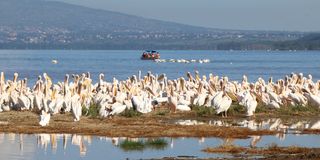
Flamgoes at the Lake Nakuru National park. Photo taken on November 30, 2024.

Years ago, a visit to the shores of Lake Nakuru or Lake Elementaita was unforgettable as a sharp, pungent scent would hang in the air, and vast stretches of pink would blanket the water.
Tens of thousands of flamingos moved together like a living tide, drawing birdwatchers and tourists from around the world, a spectacle helped cement the lakes’ global recognition as part of the UNESCO-listed Kenya Lake System in the Great Rift Valley and under international wetland protection.
Today, however, the ecosystems are under mounting pressure from climate change, pollution, habitat loss, and catchment degradation.
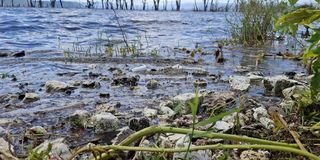
Pollution at Lake Nakuru
According to the National Wildlife Census 2025 Technical Report, wetland bird populations at Lake Elementaita declined by 97 per cent between 2023 and 2025 which is a dramatic drop highlighting the fragility of the system.
The report also describes Lake Nakuru as a “compressed yet functioning ecosystem,” now carrying high wildlife densities within a reduced footprint of just 124.4 square kilometers. Rising water levels have eaten into shoreline habitat that once supported vast flamingo congregations, shrinking feeding and nesting grounds.
Rising Rift Valley lake levels - linked to intensified rainfall patterns associated with climate change - have flooded shallow shoreline zones and disrupted the algal blooms that sustain flamingos.
For a bird whose feeding strategy depends on specific shallow, alkaline waters rich in cyanobacteria, even relatively modest ecological shifts can cascade rapidly into population declines. When water chemistry changes, the food chain is affected at its base.
Beyond climate pressures, the report also highlights additional threats like habitat degradation, pollution from surrounding agriculture and human settlements, and broader land-use pressures around the lake catchments are compounding the problem.
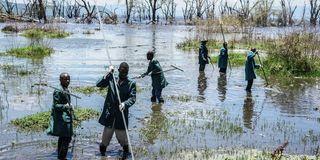
A clean up excerise happening on the shore of Lake Nakuru. The lake is currently expanded and is chocked by pollutants from the neighboring community.
Lake Nakuru’s watershed spans more than 1,800 square kilometers and includes major forest blocks such as the Mau Forest Complex, Eburu Forest, and Dundori Forest. The ecological health of these forests directly influences what flows into the lake.
Deforestation, soil erosion, and agricultural runoff do not remain on the hillsides. Instead, they contribute to siltation and altered water quality downstream, changing lake depth and chemistry over time. The report notes that catchment degradation — including sustained pressure from encroachment and illegal logging in parts of the Mau Forest Complex — has long-term consequences for Lake Nakuru’s ecological balance.
Lake Nakuru has also been affected by waste and storm water discharges linked to urban expansion, further stressing water quality. Meanwhile, Lake Elementaita faces concerns related to shoreline encroachment by hotels and tourism infrastructure, raising questions about development within sensitive wetland zones.
Both lakes lie along the African–Eurasian Flyway, a major migratory route used by millions of birds annually. Infrastructure such as power lines intersecting parts of the landscape adds another layer of risk, potentially disrupting movement patterns between wetlands.
As World Migratory Bird Day 2026 is commemorated this month, conservationists warn that the transformation of these lakes serves as a reminder of how interconnected climate systems, land management, and biodiversity are.