From convenience to crisis: The dark side of boda boda culture
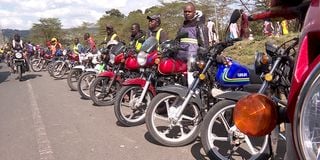
Boda boda riders parked at Soilo near the Holiness and Repentance Ministry crusade grounds.

"Uber baridi, also known as boda boda, perhaps stands out as the most convenient mode of transport. Imagine being stuck in traffic along the Nakuru-Nairobi highway, specifically on this stretch between Section 58, coming to town, all the while your boss is impatiently waiting for you in the office.
A boda boda always seems like the perfect solution at the time, to help you navigate the traffic and get to work on time.
Even though these guys come in handy from time to time, there are some things we just can’t overlook.

Coz tell me why someone would need to have LED lights, turn on your full light, and there you are on the highway leaving other motorists half blind as you pass by.
This has been a topic of discussion for the better part of this week, with road users wondering what happened to the implementation of the ban on this kind of lights, perhaps “ilikuwa tu story za jaba”.
There are these riders who always have stories for days and are always opinionated, but now what happens when I can barely hear what you are saying, and to make matters worse you have a helmet on and are going at 50 km/hr, honestly nafaa niskie aje ukisema venye broad-based hairwork?
Let us now address the elephant in the room. Sometime in December, Mtaa Wangu reported an incident where a bus which was involved in an accident in the Sachangwan area was allegedly burnt by boda boda riders. Of course, they denied it, but if the numerous other similar incidences that have happened all over the country are anything to go by, then they must not be that innocent.
We spoke to Alice Kariuki, who narrated to us how she was involved in an accident with a boda boda rider along the Nakuru-Kabarak road and how the experience left her traumatized.
“The rider was driving on my blind spot, the right side, and so I did not see him. After a while he hit my right-side mirror and he crashed. Almost immediately other boda boda riders had congregated at the scene and they started becoming rowdy, threatening to burn my car,” she says.
“There was a group that started hitting my trunk vigorously and I became scared. I immediately got into the car and got away. They started following me, and luckily there was a police stop near Gioto Dumping Site. I rushed and stopped where the traffic police were, and at least from there I was safe and we worked everything out,” she says.
After an accident there are those who remain behind, and there are those who run away, not caring in what state they leave the other person, na hio pia ni tabia mbaya.
Speaking to some boda boda operators to find out why their colleagues have such tendencies, they pointed out to the fact that there are those without insurance and therefore running is usually the safest option.