On leave, but still called: How to navigate office requests away from work
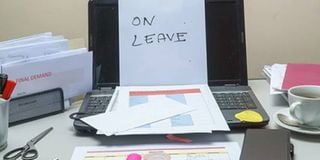
A representation of office desk with an on leave notice

Not discussing work while on leave or on designated days off is increasingly being recognised as essential for mental well-being, reducing burnout and allowing employees to fully recharge before returning to their roles.
This reality became painfully clear for Rahab Wanja, who says she was forced to quit her job shortly after taking leave for the first time since joining the company. According to Rahab, the situation deteriorated when her employer hired her replacement after she declined to work during her leave days.
“After I took leave, the first week felt as if I was still at work because my bosses and coworkers kept calling me to sort out issues at work. This was stressing me so much that I switched off my phone,” she recalls.

Rahab explains that although she disconnected for a week to rest, she later received a series of messages from her boss. In response, she made it clear that she was unavailable to handle work-related tasks at the time.
She notes that her decision was driven by burnout and the need for proper rest, adding that she had already handed over her duties to a colleague who was capable of handling the same responsibilities.
“When I came back, my boss was very cold and had already brought a new person to do my job. That’s when I decided I wouldn’t stay at the organisation for more than two months, and eventually, I quit,” she says.
Career coach Eunice Victoria notes that while some workplace cultures encourage constant availability, employees are generally not required to check emails or take calls while on annual leave or off days unless this is clearly stated in their contracts. However, she adds that the issue is not always black and white.
“It depends on the profession,” Victoria explains. “If you are, for example, a medical doctor and there is a major emergency like a bomb blast, and you refuse to respond because you are on leave, then it becomes a moral issue. In such professions, it is more of a calling.”
She adds that even in roles like coaching or consulting, there are moments when flexibility may be required. “If my client has an interview in the evening and I’m already home, I may still need to prepare them. So it really depends on the scope of work and the nature of the profession,” she says.
That said, Victoria emphasises the importance of planning and boundaries. She explains that leave should be scheduled in advance, allowing organisations to prepare and redistribute responsibilities.
“That’s why HR asks you to update your leave dates. You plan well so that when it’s time to take your one month, you can actually take it and rest, unless it’s a real emergency,” she notes.
On how employee should handle calls or messages while on leave, Victoria advises a respectful but firm approach. “Boundaries are very important. You don’t have to pick every call immediately. You can return the call after a few hours and politely explain that you’re on leave and unable to help at that moment,” she says. “Not everything is an emergency, and most things can wait.”
At the same time, she encourages courtesy and communication, acknowledging that there may be rare cases where an employee holds critical information. However, she insists that no role should be so central that operations grind to a halt in someone’s absence.
For employers, Victoria stresses the need to strike a balance between productivity and employee well-being. “Create proper systems. No employee should be so important that if they are not there, nothing works. If that’s the case, then the organisation lacks systems,” she explains.
She adds that organisations should ensure knowledge sharing and mentorship so that more than one person can perform critical tasks.
“The company is not an individual; it’s an entity. If one person is away, another should be able to hold the fort,” she says.
Victoria encourages employees to take their leave without guilt. “Take leave, create systems, and mentor others. No one can take your job because it’s about strategy and human insight. Everything else can be done by someone else. Rest is not a luxury; it’s a necessity.”