Meet Wanyororo farmer inspiring locals to embrace organic farming


When pests invade his farm, Muraya Gitau no longer rushes to the agrovet to buy a chemical pesticide. Instead, he looks around his home and farm for materials he can turn into an organic solution.
The organic farmer and trainer from Wanyororo A has gradually changed the way he farms after learning about organic agriculture through Biovision Africa Trust. Today, he not only grows his own food using organic methods but also shares the knowledge with fellow farmers, turning his farm into a practical classroom.
Muraya says his journey into organic farming started with learning how to make fertiliser from waste available at home and prepare pesticides from leaves found around his surroundings. Before then, he relied on synthetic pesticides whenever he noticed pests attacking his crops.
However, as he gained more knowledge, his understanding of pest management changed.

“Nowadays we don't kill the pests; we expel them by using organic things. Now we are eating healthy and doing great farming,” Muraya says.
And because farming is rarely about one crop alone, Muraya has embraced mixed farming on his farm, keeping animals while growing fruits, vegetables, maize and beans. The farm has also become a demonstration site where other farmers can see organic farming in practice rather than simply hearing about it in a training room.
Muraya says adopting organic farming can initially be difficult because farmers are used to seeing quick results from synthetic inputs. However, with patience and consistency, he says they begin to notice healthier crops and changes in the taste of their produce.
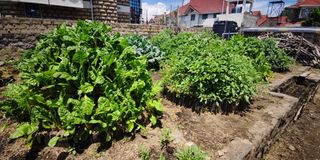
Organically grown vegetables at a kitchen garden.
It is this practical experience that Muraya believes makes peer-to-peer learning important.
“For farmers who have never tried organic farming, seeing a fellow farmer successfully grow crops without synthetic chemicals can make the idea less intimidating. If they come and see what I've done on my farm, they will see that I've not used any chemicals,” he says.
Among the farmers who have experienced this change is Mary Mathenge from Dundori.
For years, Mary relied on synthetic inputs to grow vegetables. However, about three years ago, she was trained by Muraya and began learning how organic inputs could be incorporated into her farming.
The lessons did not stop at identifying organic alternatives. Mary was also taught how to prepare some of the inputs herself, giving her an opportunity to reduce her dependence on commercially purchased farm chemicals.
Since then, she has carved out a niche growing African nightshade ‘managu’, a traditional vegetable that has attracted customers looking for organically grown food.
Interestingly, Mary says the challenge has now shifted from convincing people to buy her produce to keeping up with demand.
Once customers learn that her managu is organically grown, she says, interest increases, sometimes leaving her unable to satisfy the market.