Maize and Potato production record significant drop in four years
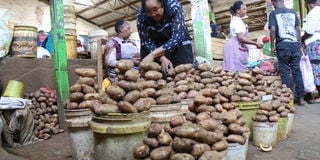
A trader arranges her potatoes at Wakulima Market on September14 which are currently shot in price.

Maize and potatoes production has continued to drop despite steady expansion in the land under cultivation.
Data from the Kenya Agricultural Report 2025 by the Kenya National Bureau of Statistics (KNBS), which tracks acreage and production trends between 2020 and 2024, shows that increases in land allocation have not translated into proportional gains in output.
In maize production, Nakuru recorded 64,963 hectares in 2020, yielding 206,876 tonnes. While acreage and production rose in 2021 to 87,651 hectares and 242,825 tonnes respectively, the trend reversed in subsequent years. In 2022, maize acreage declined to 66,315 hectares and production dropped to 213,786 tonnes.

Although acreage expanded again to 71,470 hectares in 2023, output stagnated at 215,412 tonnes. In 2024, maize acreage increased significantly, yet production fell to its lowest level in four years at 201,876 tonnes.
A similar pattern was observed in potato production. In 2020, potatoes were grown on 29,868 hectares, producing 372,105 tonnes. Both acreage and output increased in 2021 to 40,285 hectares and 422,207 tonnes, and continued to rise through 2022 and 2023, peaking at 49,981 hectares and 657,091 tonnes.
However, despite further expansion of acreage in 2024, potato production declined sharply to 476,876 tonnes, making it the third lowest output recorded over the four-year period.
According to Alex Ng’etich, a project officer at the Cereals Growers Association, the widening gap between acreage expansion and productivity reflects deeper structural and agronomic challenges.
He notes that increased land under cultivation does not automatically result in higher yields if underlying constraints remain unresolved.
"One of the major limiting factors, particularly in potato production, is the inadequate supply of quality certified seed. The continued use of farmer-saved seed, combined with limited access to and affordability of certified seed, has contributed to the spread of pests and diseases such as bacterial wilt and potato cyst nematodes, significantly undermining yields," he says
He says that unstructured markets, weak aggregation systems, and unreliable buyers often lead to market gluts, discouraging farmers from investing in productivity-enhancing inputs.
Ng'etich adds that poor road infrastructure in key potato-growing areas increases transportation costs and delays timely delivery to markets, further reducing profitability.
Other factors he said declining soil fertility poor management of pests and diseases as well as that erratic rainfall patterns and recurrent drought stress, and limited irrigation infrastructure have reduced yield stability.
To reverse these trends, he argues that the focus must shift from acreage expansion to yield intensification through strengthening advance booking and distribution of certified seed supporting local seed multiplication initiatives, and expanding partnerships with off-takers, especially for processing varieties.
"Improved post-harvest handling training, involving trained harvest service providers, is also seen as critical in reducing losses," he says