Innovation: Young farmers in Rongai venture into cricket farming
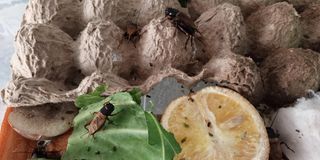
Crickets feeding in organic waste

A youth-led community-based organisation in Nakuru is embracing cricket farming as an innovative solution to the rising cost of poultry feeds while opening up new opportunities for youth employment, nutrition and sustainable agriculture.
Jamii Ajibika Self Help Group, which operates under the Jamii Ajibika Community-Based Organisation (CBO), has ventured into cricket farming as part of its Youth Voice Programme, an initiative aimed at socially and economically empowering young people.
According to the organisation's representative, Collins Odhiambo Oduor, the group began exploring alternative protein sources after realising that expensive commercial feeds were discouraging many young people from venturing into poultry farming.

"We conducted extensive research, including learning from Jomo Kenyatta University of Agriculture and Technology, and identified cricket farming as a sustainable alternative source of protein for poultry feed formulation," said Oduor.
He noted that the group is currently at the incubation stage, with cricket populations steadily increasing as they work towards scaling up production.
Currently, the harvested crickets are processed into ingredients for poultry feed, with poultry farmers forming their primary market and organic manure. However, the organisation has bigger ambitions for the future.
"We are looking at the entire cricket value chain. Beyond poultry feeds, we want to venture into value addition by producing cricket powder for porridge, baking cakes, samosas and other food products for human consumption," he explained.
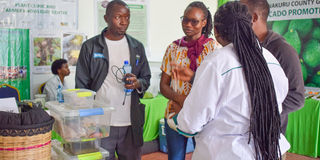
Collins Odhiambo from Jamii Ajibika Self Help Group (in green dust coat) during the Nakuru Agricultural Show explaining to show attendees on cricket farming.
Besides cricket farming, the organisation also operates large-scale poultry farming in Kapkures and manages cricket incubation facilities at its Ol Rongai farm. The group further promotes climate-smart urban agriculture through automated kitchen gardens that utilise nutrient-rich cricket manure as organic fertiliser.
Oduor said the circular production model ensures that nothing goes to waste, with vegetable scraps feeding the crickets while cricket waste enriches vegetables such as kale and spinach.
Despite the promising venture, the organisation faces several challenges, including the high cost of infrastructure and equipment needed for poultry houses, cricket production and value addition.
"We have the knowledge and innovation, but limited resources have slowed our expansion. We would appreciate partnerships with the county government and development partners to enable us to reach more vulnerable youth," he said.
Founded with just 30 members, Jamii Ajibika has grown to 82 young people and continues to attract more youth from Nakuru Town East.
Oduor also called for greater public awareness on alternative protein sources, saying misconceptions remain a major barrier to the adoption of insect farming.
"There is still a huge knowledge gap. Many people believe protein can only come from meat, fish or chicken, yet research shows there is a growing protein deficiency. Cricket farming offers an affordable, nutritious and environmentally friendly solution," he said.
Looking ahead, the group hopes to expand production, invest in value addition equipment and eventually access export markets, while ensuring Nakuru residents are the first to benefit from the emerging enterprise.