Illegal fishing, flooding lakes linked to drop in fish production in Nakuru
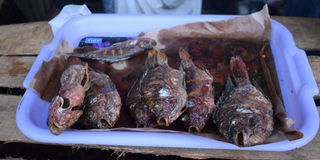
Display of fried fish from Lake Nakuru by some local traders at the shores of Lake Nakuru.

Fish production in Nakuru County continues to fluctuate, with recent declines linked to climate change, overfishing, flooding, and illegal harvesting, according to the National Agriculture Production Report 2025.
Fish production from Lake Naivasha has declined sharply over the past five years, dropping from 2,216 tons valued at Sh238.6 million in 2020 to just 1,020 tons worth Sh118.7 million in 2024.
After falling to 1,804 tons in 2021, catches briefly recovered in 2022 to 2,190 tons - the highest value recorded at Sh263.7 million - before plunging to 1,140 tons in 2023 and continuing the downward trend in 2024

County Director of Fisheries Raymond Mwangata says the changes are driven by a combination of environmental and human factors that have intensified over time.
“Considering that the population is also growing, that means our fishing effort is not constant. It is keeping on increasing,” Mwangata says.
He notes that climate variability, especially flooding of the Rift Valley lakes, has significantly affected fish catches.
“When we have floods, the water extends, and the surface area of the lake also extends. So with the same fishing effort, you take a lot more effort to harvest one kilo,” he says. “It is like the fishing ground is increasing.”
Mwangata adds that flooding also disrupts fish breeding patterns.
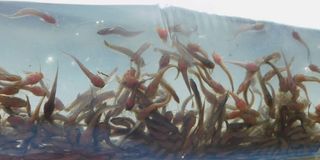
Fingerings restocked are Lake Naivasha in 2025
“During that season, most of the fish go to breeding grounds, so the catches generally go down,” he notes.
He further says that weather changes and rising temperatures affect fish survival and reproduction, contributing to fluctuations in production.
The fisheries director also points to illegal, unreported, and unregulated (IUU) fishing as a major driver of declining official production figures.
“There was also the issue of poaching. People have harvested, yes, but this is lost data because it is not recorded,” he says.
Mwangata opines that proximity to urban centers has additionally intensified fishing pressure, particularly in Lake Naivasha.
“Naivasha is very close to town, so everyone wants to be caught there. At the end of the day, you overfish, and it continues to diminish gradually because of the pressure,” he says.
Despite the challenges, he notes that targeted interventions have helped stabilize production.
“In 2023, we restocked Lake Naivasha with 150,000 fingerlings,” Mwangata says. “In 2024 and 2025, the fishing community further restocked with 200,000 fingerlings.”
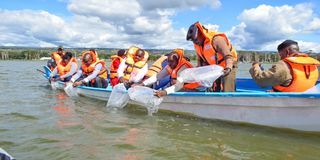
Restocking happening in Lake Naivasha in 2025
He adds that early indicators suggest a modest recovery.
“Although we have not validated the data, it is coming around 1.5 metric tonnes,” he says.
On historical trends, Mwangata says 2022 recorded higher production compared to 2023, largely due to favorable conditions before flooding disrupted fishing patterns.
“When we talk about fluctuations, it is not a gradual reduction. You have up and down productions,” he says.
He notes that the county has moved to other lakes like Solai and small community dams, and supplement from aquaculture at the household level.