How Nakuru built Kenya's supermarket giants
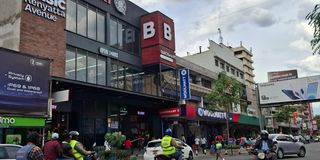
Quickmart outlet along Kenyatta Avenue trace their beginnings to Nakuru.

Long before Kenya’s supermarket shelves were dominated by national chains, some of the country’s biggest retail names were taking shape in Nakuru.
The town has an unusual place in Kenya’s retail history with Naivas, Nakumatt, Tuskys and Quickmart all tracing important parts of their beginnings to Nakuru, while family businesses such as Gilani’s built enduring retail operations from the town.
Nakuru’s position as a regional commercial centre, along the routes connecting Nairobi to the Rift Valley and western Kenya, gave local businesses access to a large and growing market beyond the town itself.
Perhaps the most curious part of that history is that two of the country’s best-known supermarket names began with mattresses.
Nakumatt’s name was derived from Nakuru Mattresses, a business established in Nakuru by the Shah family. What started as a mattress and household-goods business eventually grew into one of Kenya’s largest supermarket chains, with branches across the country and in neighbouring countries.
Tuskys has a similarly humble origin when its founder, Joram Kamau, started out in retail in Rongai. Accounts of the business trace its early days to a small shop that sold mattresses and other goods before the enterprise expanded into supermarkets.
Naivas’ early history is tied to the same Kamau family retail story behind Tuskys. In 1990, Joram Kamau left the Rongai business to his nephews, David Kimani and Simon Mukuha. The business, which had roots in Gitwe General Stores, went through several iterations before becoming Naivas.
Other than the three, Quickmart also founded in Nakuru in 2006 by John Kinuthia is a family-owned supermarket. From its first store, the business expanded beyond Nakuru and eventually became a national chain.
Gilani’s is another household name in Nakuru and what began as a grocery shop has remained locally rooted through successive generations
Unlike the supermarket chains that expanded across the country, Gilani’s has remained a homegrown retailer with a lasting presence within the town itself.
Cumulatively, these businesses give Nakuru an unusual place in Kenya’s retail history and helped pave the way for other locally owned businesses operating outside the supermarket sector.
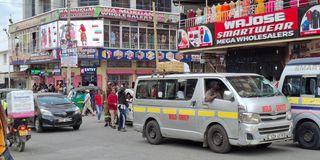
Wajose and Warmogan outlets along Mburu Gichua road, who form part of these newer generation of homegrown retailers, particularly in the clothing and fashion space.
As the town’s retail economy expanded, so did the space for locally owned businesses dealing in clothing, footwear, household goods and general merchandise.
The town has developed a sizable ecosystem of clothing, footwear, household-goods and general merchandise retailers, many of which have built their identities around the local market.
Businesses such as Wajose and Wamorgan are part of this newer generation of homegrown retailers, particularly in the clothing and fashion space who have formed part of recognizable brands of their own.
Other businesses, including Stagematt, Rivanas and Haraka Kanini, have also featured in accounts of Nakuru’s retail history, reflecting a commercial culture that extends beyond the famous supermarket names.
The town has repeatedly provided fertile ground for indigenous retail businesses.
And perhaps the strangest footnote in that history is that before some of Kenya’s biggest supermarkets were selling everything from groceries to electronics and clothing, their predecessors were selling something much simpler, Mattresses.